JellyBlue Official Website › How It Works
How It WorksHow JellyBlue Works: Four Routes and Four Kinds of Evidence
Nothing on this bottle claims a mechanism and neither does this desk. What can be described is why these seven things were put in one gummy: three act on blood flow, one on stress, two on androgen pathways, and one is there by tradition. The evidence behind those four routes is not equal.
The reasoning behind the formula, with the quality of evidence stated for each part of it.
Route one: the blood-flow ingredients in JellyBlue
Three of the seven sit on this route and together they are 150 mg of the 650 mg in a gummy: L-arginine HCl, beet root and grape seed.
The end point is nitric oxide, a short-lived gas that signals the smooth muscle in blood-vessel walls to relax, which widens the vessel and increases flow. There are two ways to reach it and this label uses both.
The classical route runs through L-arginine, which the enzyme nitric oxide synthase converts directly. It is the version every advertisement in this category describes, and it is real. The difficulty is that oral arginine is poorly absorbed and heavily metabolised on the way, which is why the trials pooled in a network meta-analysis of supplement ingredients for erectile function use one and a half to five grams a day rather than milligrams.
The shorter route runs through dietary nitrate, which is what beet root carries. Microbes that live at the back of the tongue turn that nitrate into nitrite, and the nitrite becomes nitric oxide once it is in the bloodstream, most readily where oxygen is scarce. The beetroot juice trial that opened this literature demonstrated the effect with 500 mL of beetroot juice, and a meta-analysis of beetroot nitrate and blood pressure pools the trials in people with raised blood pressure. It is a food-dose effect, which is the interesting part.
Grape seed is the third, and it works on the vessel rather than on the signal: its proanthocyanidins have been measured against flow-mediated dilation and blood pressure in the trials pooled by a dose-response meta-analysis of grape seed extract. The arms there run from 100 to 800 mg a day.
Route two: the stress ingredient in JellyBlue
Ashwagandha, at 100 mg, and this is the least glamorous part of the formula and quite possibly the most sensible.
The argument is straightforward and does not require any hormonal claim at all. Sustained stress and short sleep flatten energy, mood, appetite and drive, and they do it in a way every reader recognises from their own life. Ashwagandha's withanolides have been studied against exactly that, in adults reporting high stress and fatigue: a randomised trial of ashwagandha in stressed adults ran sixty days at 240 mg a day, and an eight-week ashwagandha trial in overweight men aged 40 to 70 gave 600 mg a day. A meta-analysis of ashwagandha's hormonal effects pools the hormonal end of the same literature.
For a man in his late forties wondering why the tank is empty, this is more often the answer than anything to do with androgens, and it is the route on which this panel's amount comes closest to a studied one without reaching it.
If chronic stress and five hours of sleep are the problem, then a hundred milligrams of ashwagandha is a smaller lever than a bedtime. The gummy is not competing with sleep and this desk is not going to pretend otherwise. What it can reasonably be is a small daily nudge on top of the things that actually move the dial.
Route three: the androgen ingredients in JellyBlue
Tongkat ali at 200 mg and maca root at 100 mg, and this is where the seller's page and this desk part company most sharply.
Tongkat ali is the real one. A 2022 meta-analysis of tongkat ali trials reported an increase in serum total testosterone in men, drawing on arms that ran 200 to 400 mg a day. A six-month randomised trial in older men gave 400 mg a day to men with age-related androgen decline, with and without training. At 200 mg this gummy is at the foot of that range rather than outside it.
Maca is not an androgen ingredient, and its own trials say so. The 12-week maca trial in healthy men found improved self-rated sexual desire from week eight while explicitly reporting no change in serum testosterone or oestradiol, and a systematic review of the maca trials reached the same conclusion across the literature. Whatever maca does, it does not do it hormonally. Advertising that groups it with tongkat ali under a hormone heading is describing a formula the research does not support.
The amounts matter here more than anywhere. The maca trials used one and a half to three grams a day, which is a food quantity. A hundred milligrams is a fifteenth of the smallest of them.
Route four: the traditional ingredient in JellyBlue
Horny goat weed, 100 mg. It is the botanical this whole category is named for in half the world's shops, and it is the one with the widest gap between reputation and measurement.
What is true: Epimedium has centuries of documented use for this purpose, and its marker compound icariin is genuinely interesting in laboratory work. What is also true: there is no randomised human trial of the herb for this use case to point a reader at, and a supplement page that implies one is misleading its reader.
The most useful published work here is the standardisation work on Epimedium, which is about batch consistency rather than effect. Its finding is the practical one: Epimedium preparations vary enormously between species and between batches, so a label reading “100 mg of Epimedium extract” does not pin down a fixed quantity of anything. A 2026 meta-analysis of herbal supplements in this category is the best current overview of what the herbal evidence base looks like as a whole.
What JellyBlue cannot do, stated once
A gummy carrying 650 mg of mixed plant extracts is a small intervention. It is not a treatment for any condition, it is not a hormone, and it is not a substitute for a medical answer to a medical question. The label claims three supports and this website claims the same three.
The things that move male energy and drive fastest are not on this panel at all: sleep, alcohol, weight, training and what a physician might find if asked. This desk sells a supplement and still says that plainly, because a page that pretends otherwise is not worth trusting on the parts where it is being straight.
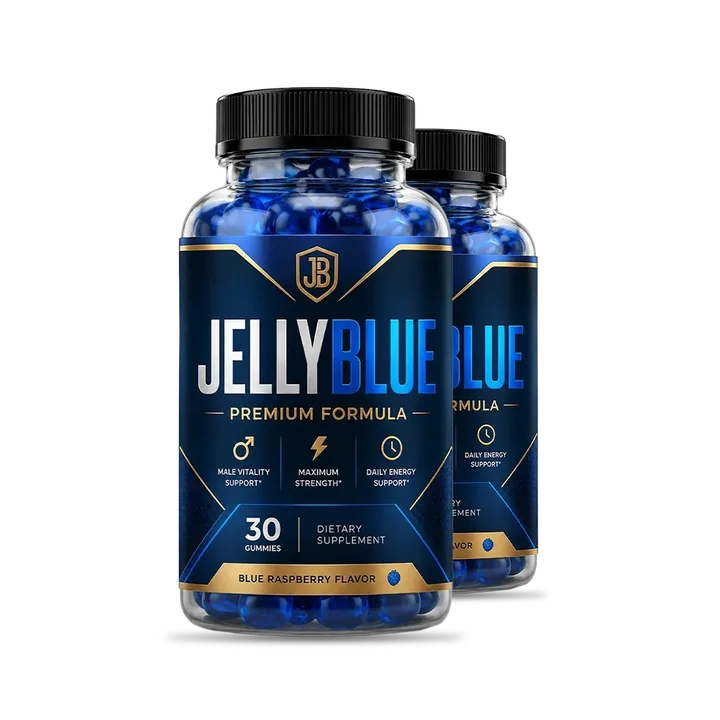
Order JellyBlue with the mechanism written down
Four routes, four different qualities of evidence, all of it set out above before you buy rather than after. Sixty days from purchase either way.
Two bottles $158 · three bottles $207 · 60-day money-back guarantee
Order JellyBlue On The Official Website30 gummies a bottle · lot JEL-26/JE-6782 · ships from the U.S.
Who publishes this JellyBlue website?
Every trial named above, in the order the routes appear.
- Leisegang K, Finelli R, Sikka SC, Panner Selvam MK. Eurycoma longifolia (Jack) improves serum total testosterone in men: a systematic review and meta-analysis of clinical trials. Medicina (Kaunas). 2022;58(8):1047. PMID 36013514. https://pubmed.ncbi.nlm.nih.gov/36013514/
- Leitão AE, Vieira MCS, Pelegrini A, da Silva EL, Guimarães ACA. A 6-month, double-blind, placebo-controlled, randomized trial to evaluate the effect of Eurycoma longifolia (Tongkat Ali) and concurrent training on erectile function and testosterone levels in androgen deficiency of aging males (ADAM). Maturitas. 2021;145:78-85. PMID 33541567. https://pubmed.ncbi.nlm.nih.gov/33541567/
- Gonzales GF, Córdova A, Vega K, et al. Effect of Lepidium meyenii (MACA) on sexual desire and its absent relationship with serum testosterone levels in adult healthy men. Andrologia. 2002;34(6):367-72. PMID 12472620. https://pubmed.ncbi.nlm.nih.gov/12472620/
- Shin BC, Lee MS, Yang EJ, Lim HS, Ernst E. Maca (L. meyenii) for improving sexual function: a systematic review. BMC Complement Altern Med. 2010;10:44. PMID 20691074. https://pubmed.ncbi.nlm.nih.gov/20691074/
- Lopresti AL, Drummond PD, Smith SJ. A randomized, double-blind, placebo-controlled, crossover study examining the hormonal and vitality effects of ashwagandha (Withania somnifera) in aging, overweight males. Am J Mens Health. 2019;13(2):1557988319835985. PMID 30854916. https://pubmed.ncbi.nlm.nih.gov/30854916/
- Fornalik M, Malkiewicz A, Adamczak D, et al. Hormonal modulation with Withania somnifera: systematic review and meta-analysis of randomized-controlled trials. Planta Med. 2026;92(8):790-805. PMID 41740946. https://pubmed.ncbi.nlm.nih.gov/41740946/
- Smith SJ, Lopresti AL, Fairchild TJ. Exploring the efficacy and safety of a novel standardized ashwagandha (Withania somnifera) root extract in adults experiencing high stress and fatigue in a randomized, double-blind, placebo-controlled trial. J Psychopharmacol. 2023;37(11):1091-1104. PMID 37740662. https://pubmed.ncbi.nlm.nih.gov/37740662/
- Yong EL, Wong SP, Shen P, et al. Standardization and evaluation of botanical mixtures: lessons from a traditional Chinese herb, Epimedium, with oestrogenic properties. Novartis Found Symp. 2007;282:173-88. PMID 17913231. https://pubmed.ncbi.nlm.nih.gov/17913231/
- Barbonetti A, Tienforti D, Antolini F, et al. Nutraceutical interventions for erectile dysfunction: a systematic review and network meta-analysis. J Sex Med. 2024;21(11):1054-1063. PMID 39279185. https://pubmed.ncbi.nlm.nih.gov/39279185/
- Ho CY, Hsu CH, Chien TJ. Herbal dietary supplements for erectile dysfunction: a systematic review and meta-analysis of randomized-controlled trials. J Tradit Complement Med. 2026;16(1):109-120. PMID 41696741. https://pubmed.ncbi.nlm.nih.gov/41696741/
- Webb AJ, Patel N, Loukogeorgakis S, et al. Acute blood pressure lowering, vasoprotective, and antiplatelet properties of dietary nitrate via bioconversion to nitrite. Hypertension. 2008;51(3):784-90. PMID 18250365. https://pubmed.ncbi.nlm.nih.gov/18250365/
- Benjamim CJR, Porto AA, Valenti VE, et al. Nitrate derived from beetroot juice lowers blood pressure in patients with arterial hypertension: a systematic review and meta-analysis. Front Nutr. 2022;9:823039. PMID 35369064. https://pubmed.ncbi.nlm.nih.gov/35369064/
- Foshati S, Nouripour F, Sadeghi E, Amani R. The effect of grape (Vitis vinifera) seed extract supplementation on flow-mediated dilation, blood pressure, and heart rate: a systematic review and meta-analysis of controlled trials with duration- and dose-response analysis. Pharmacol Res. 2022;175:105905. PMID 34798267. https://pubmed.ncbi.nlm.nih.gov/34798267/