JellyBlue Official Website › Choosing A Gummy
Choosing A GummyHow to Choose a Male Vitality Gummy
Five checks, in order, and they take about four minutes with the box in your hand. Find the Supplement Facts panel, count the amounts, compare them against the trials, work out what the extract is, and find out who you would ring. Most bad purchases fail one of the first two.
A method for reading a label in this aisle, applicable to any brand including the one this website sells.
Why a gummy is a different problem from a capsule
Start here, because it explains most of what a gummy label looks like.
A capsule is a container. You can fill a size 0 capsule with something over half a gram of powder and it will still be swallowable. A gummy is not a container: it is a confection, and the active material has to dissolve or suspend in a sugar and pectin matrix that must still set, taste acceptable and hold its shape for two years.
The practical limit is a few hundred milligrams of extract per piece before texture and taste start to suffer, and botanicals are bitter. That is why gummy panels in this category cluster between 300 and 800 mg of total actives while capsule panels routinely carry two or three grams.
The consequence is not that gummies are bad. It is that a gummy makes a specific trade: adherence in exchange for amount. A product you take every day for three months at a small amount may well beat a product you take for nine days at a large one. What is not acceptable is a gummy label pretending it has made no trade at all.
The five checks, in order
Find the Supplement Facts panel and read it, not the front
The front of a box is advertising. The panel on the back is the regulated statement, and where the two disagree the panel is the one the manufacturer is answerable for. Check it against the advertising while you are there: on the product this website sells, the seller’s page and the panel disagree about how many ingredients are in the bottle, and the panel is right.
Check there is a figure against every line
A single proprietary blend weight covering six botanicals is the most common way a label avoids saying anything. You cannot evaluate it, no reviewer can evaluate it, and the manufacturer knows that. A figure against every line is the minimum standard and it is not universal.
Compare the two or three biggest figures against the trials
Not all seven: the largest two or three, because they are where the money went and they decide the product. Use the table in the buyer's guide. If the biggest number on the panel is a tenth of the smallest trial amount for that ingredient, you are buying a list of names.
Look for an extract ratio
A ratio like 10:1, or a standardisation like “2% eurycomanone”, tells you how concentrated the extract is and therefore what the milligram figure means. Without one, a 200 mg line could be a strong extract or dried powder. Most labels in this category do not give one, which makes the ones that do worth noticing.
Find out who you would ring
A company name, a telephone number, a returns address and a stated refund window with a stated start date. If a label or a website gives you fewer than four of those, the guarantee on the front of the box is decoration.
Four things on a label that mean less than they look
“Clinically dosed”
An unregulated phrase with no definition. The only way to test it is the third check above, one ingredient at a time. A product that is genuinely clinically dosed will usually tell you which trial it is matching, because that is a much stronger claim.
“Doctor formulated”
Worth exactly as much as the name beside it. With a named clinician and a credential it is a checkable claim. Without one it is a roundel. Most labels in this aisle carrying the phrase name nobody at all.
“FDA registered facility”
A registration, not an approval. Every facility supplying the United States is required to register. The FDA's dietary supplements page sets out what supplement regulation actually involves, and it is worth five minutes because this one mark is misread more than all the others combined.
“Natural” and “proprietary”
The first has no legal definition in this context. The second means the manufacturer has chosen not to tell you the amounts, and it is presented as a virtue precisely because it is a withholding.
Working the method on a real label
| Where it is printed | What it says | What it lists |
|---|---|---|
| The seller’s sales page | six named ingredients | Tongkat ali, maca root, ashwagandha, horny goat weed, L-arginine HCl and grape seed extract. No amount against any of them, and no beet root. |
| The printed Supplement Facts panel | seven actives, with milligrams | The six above plus beet root extract at 50 mg, and a figure beside every one of them. This is the regulated statement on the container. |
The panel is the regulated statement on the container and the only one of the two carrying amounts, so where they disagree this website prints the panel.
The product this website sells is a reasonable worked example, and it makes the first check vivid. The seller’s advertising and the printed panel give two different ingredient counts, so a buyer who reads only the advertising gets a different formula from one who turns the bottle over.
On the remaining checks it scores as follows. A figure against every line: yes. Biggest figures against the trials: tongkat ali at 200 mg is inside its trial range, ashwagandha at 100 mg is below the lowest published amount. Extract ratio: not stated, which is the weakest point on the label. Who to ring: a New York office, a returns address, a telephone number and sixty days from purchase.
Three passes, one partial and one fail. That is a usable result, it took four minutes, and it is exactly the arithmetic this website would rather a buyer did than take anybody’s word for it.
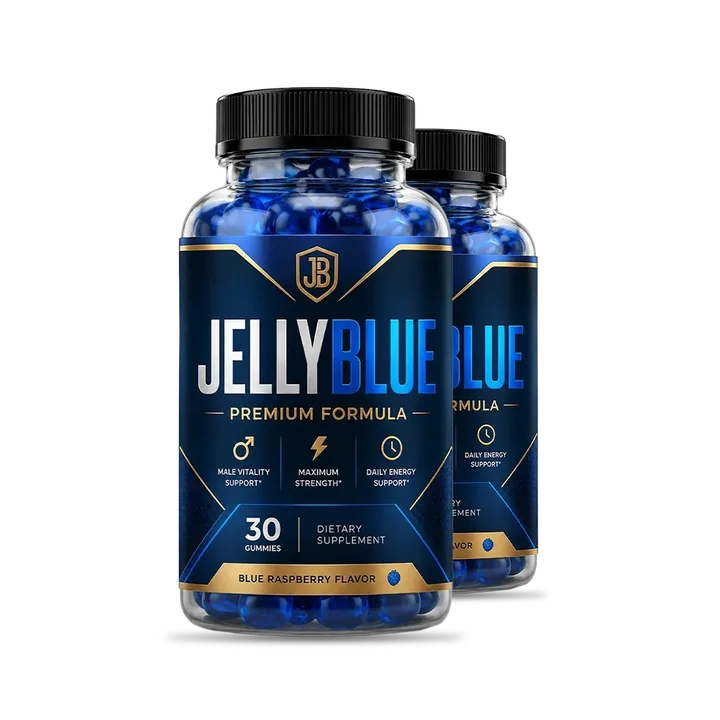
Order JellyBlue having applied the five checks
A figure against every line, one active inside its trial range, and a company with an address and a telephone number behind the sixty-day window.
Two bottles $158 · three bottles $207 · 60-day money-back guarantee
Order JellyBlue On The Official Website30 gummies a bottle · lot JEL-26/JE-6782 · ships from the U.S.
Who publishes this JellyBlue website?
The sources cited in this guide.
- U.S. Food and Drug Administration. Dietary Supplements. Accessed 21 September 2026. https://www.fda.gov/food/dietary-supplements