JellyBlue Official Website › Testing & Quality
Testing & QualityJellyBlue Testing and Quality: What Each Trust Mark Rests On
This website shows four trust marks, and each one rests on something you can check. The label prints “manufactured in the USA”; the seller’s own page states GMP manufacture and natural ingredients; the 60-day guarantee is the seller’s refund policy. Stock marks that neither the label nor the seller backs, such as “doctor formulated”, are shown greyed and marked as not claimed.
Each mark, what it rests on, what it does not certify, and the stock marks this website will not claim.
The JellyBlue marks that describe the factory
 Made in the USAPrinted on the back label, and qualified there precisely: “manufactured in the USA with globally sourced ingredients”, which means the plants themselves may come from anywhere.
 GMP manufactureThe seller’s page states the gummy is made in a facility that follows Good Manufacturing Practice. GMP is a real standard about process, records and cleanliness. It names no certifying body here, and it says nothing about whether an ingredient works.
One factory mark is absent on purpose. Neither the label nor the seller’s page states an FDA facility registration, so this website does not show that seal. It would not mean approval anyway: the FDA's dietary supplements page sets out how these products are regulated. A supplement does not need approval before sale, the manufacturer is responsible for its safety and its labelling, and the agency acts afterwards. No dietary supplement is FDA-approved, and this one is not either.
The JellyBlue marks that describe the product and the terms
 Natural ingredientsThe seller’s page says “100% natural ingredients”. The word has no legal definition in this context and no issuing body, and the panel’s cane sugar and glucose syrup are as natural as its botanicals.
 Money-backNot a property of the product. It is the seller’s refund policy rendered as a badge: sixty days, counted from the date of purchase.
Two marks, and they are different kinds of thing. One is a sourcing word that can be checked against the other-ingredients line in thirty seconds, which is the most useful thing about it. The other is a commercial policy wearing the costume of a certification, which is worth noticing even though the policy itself is a good one.
Stock marks you may see elsewhere, and why this JellyBlue website does not claim them
Stock badges like these turn up on supplement listings all the time. They are shown here greyed, for recognition only, because neither the label nor the seller’s page makes any of these claims for this gummy, and a badge is only as good as the statement behind it.
 Not claimedDoctor formulatedNeither the label nor the seller’s page says a doctor formulated this gummy, or names who did.
 Not claimedFDA registeredNo facility registration is stated. It would describe a factory, never approve a product.
 Not claimedVegetarianThe gel is pectin, which is consistent with it. Consistent is not claimed, and the colouring is unspecified.
 Not claimedGluten freeThe panel’s “starch” line does not name its source, so this cannot be read off the label.
 Not claimedDairy freeNo dairy source is listed, but neither the label nor the seller states the claim.
 Not claimedGMO freeA raw-material sourcing claim nobody makes for this product, and not checkable from the panel.
If one of those matters to you, ask the order line before ordering rather than relying on a badge. For these six there is no statement to rely on.
What would actually improve the JellyBlue label
This is the section where a retailer is supposed to say everything is excellent. Four things would genuinely improve this label, in order of how much difference they would make.
Extract ratios
Every botanical line reads “extract” with no ratio and no marker standardisation. A 10:1 tongkat ali and a 1:1 at the same 200 mg are different products. This single addition would do more for the label than any badge.
A named formulator
Neither the label nor the seller’s page says who formulated the gummy. A named person with a credential would be a checkable fact, and it would cost nothing to print.
A published certificate of analysis
The certificate reference JEL-6782-26-JE is a reference number, not a result. A published, downloadable assay per lot, showing identity and heavy metals, is the industry’s best practice and it is not what this product provides.
One list of ingredients rather than two
The seller’s page lists six ingredients and the printed panel lists seven. Adding beet root to the advertising so that it matches the panel would cost the seller nothing.
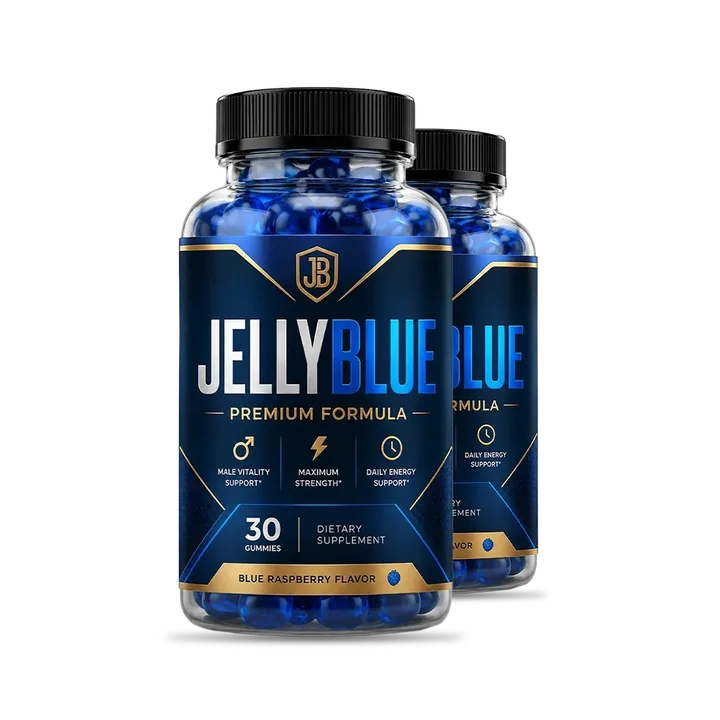
Order JellyBlue knowing what each trust mark rests on
Four marks, each with the statement behind it, and six stock marks this website will not claim because nothing backs them. Sixty days from purchase either way.
Two bottles $158 · three bottles $207 · 60-day money-back guarantee
Order JellyBlue On The Official Website30 gummies a bottle · lot JEL-26/JE-6782 · ships from the U.S.
Who publishes this JellyBlue website?
The regulatory sources cited above.
- U.S. Food and Drug Administration. Dietary Supplements. Accessed 21 September 2026. https://www.fda.gov/food/dietary-supplements