JellyBlue Official Website › Side Effects
Side EffectsJellyBlue Side Effects, Cautions and the Interaction Worth Naming
Nothing on this panel is a stimulant, and neither the label nor the seller lists a side effect. The realistic nuisances are a sweet chew on an empty stomach and the sugar. The one interaction worth a specific conversation involves blood thinners, nitrates and blood-pressure medicines.
Written as a safety page, which means the cautions here are repeated where they need to be rather than quarantined.
What a JellyBlue buyer can realistically expect
The distributor’s published reviews name one dislike, a slow start, and describe no reaction. That is not evidence of safety: they are unverified testimonials, and neither the distributor nor this website publishes an adverse-event record. What can be said is what the label itself predicts, and that is set out below.
| What you might notice | Why, from the label | What to do about it |
|---|---|---|
| Nothing at all in week one | No stimulant on the panel, and the trials behind it measured at eight and twelve weeks | Expected. See the timeline. |
| An unsettled stomach taking it before food | The label suggests 20 to 30 minutes before a meal, and a sweet, acidic chew on an empty stomach does not suit everyone | Take it with the meal instead. The before-a-meal line is a preference for best results, not an instruction. |
| Gummies stuck together in the bottle | Heat. The label asks for a cool, dry place away from heat and light | Store it cool and out of the sun; they separate once cooled. Not a safety issue. |
| Too sweet | 1.5 g of sugar a piece, from cane sugar and glucose syrup | That is what makes a pectin gummy a gummy. A capsule product is the alternative. |
Reasoning from the printed label, not a record of reports. Anything that persists or worries you is a reason to stop and ask a clinician.
The one JellyBlue interaction worth a specific conversation
Most supplement pages say “talk to your doctor if you take medication” five times and name nothing. Here is the actual question, once, in enough detail to be useful.
Three ingredients on this panel touch blood flow or platelets. Beet root carries dietary nitrate, which the body converts to nitric oxide. Horny goat weed and grape seed have both been associated with effects on platelet behaviour and vessel dilation. Individually, at these amounts, none of that is likely to matter.
Where it does matter is alongside three classes of medicine. A prescribed nitrate works through the same nitric oxide pathway as beet root does, and that combination belongs to whoever prescribed it. A blood thinner such as warfarin or a direct oral anticoagulant sits beside two botanicals with antiplatelet activity. A blood-pressure medicine is being titrated against a target, and a meta-analysis of beetroot nitrate and blood pressure and a meta-analysis of sixteen grape seed trials are both about blood-pressure movement, small but measurable at their trial amounts.
The question to ask is narrow enough to be answered: “I want to take a daily gummy containing beet root 50 mg, grape seed 50 mg and Epimedium 100 mg alongside my [drug]. Is there anything you would rather I did not?” That is a thirty-second conversation with a pharmacist and it is worth having once.
If you are prescribed sildenafil, tadalafil or a related medicine, the nitrate-pathway caution above applies with more force, because those medicines and nitrates are a combination prescribers avoid deliberately. The amount of nitrate in 50 mg of beet root extract is very small. It is still the one question on this page this desk would want asked before the first gummy.
Ingredient-level cautions behind the JellyBlue panel
Ashwagandha and the liver
There is a real and growing case-report literature on ashwagandha-associated liver injury, gathered in a 2026 scoping review of ashwagandha liver injury, and NCCIH on ashwagandha carries the same caution in plainer language. The reports involve much larger daily amounts than 100 mg and the events are rare, but anyone with existing liver disease has a reason to skip this ingredient, and anyone who develops unexplained fatigue, dark urine or yellowing should stop and be seen.
Ashwagandha and the thyroid
Ashwagandha has been reported to raise thyroid hormone levels in some people. For a man on thyroid replacement whose dose is being managed to a number, that is a reason to mention it at the next blood test rather than a reason for alarm.
Tongkat ali and quality
The ingredient itself has a reasonable tolerance record in the trials summarised by the standing pharmacology and toxicology review of tongkat ali. The issue in this category has historically been sourcing rather than pharmacology, which is the argument for buying from a seller who can match a lot number to a batch.
Epimedium and what is in the bottle
The standardisation work on Epimedium is about batch variability rather than toxicity, and that is the honest caution: Epimedium preparations differ so much between species and suppliers that a stated milligram does not pin down what is inside. This is the least characterised line on the panel.
The JellyBlue label caution, printed in full
Do not exceed recommended dose. Pregnant or nursing mothers, children under the age of 18 and individuals with a known medical condition should consult a physician before using this or any dietary supplement. Keep out of reach of children. Do not use if safety seal is damaged or missing.Caution, printed on the back label
That is the manufacturer's own wording and this desk reproduces it rather than paraphrasing it. Three parts of it are absolute: the age limit, pregnancy and nursing, and the safety seal. The fourth, about a known medical condition, is the one the interaction section above turns into a question you can actually ask.
One more line belongs here for completeness. A dietary supplement is not reviewed or approved by the FDA before it is sold; the FDA's dietary supplements page sets out what that does and does not mean. The trust marks shown on this website describe a factory and a sourcing policy, not an approval, and the testing and quality page goes through each one.
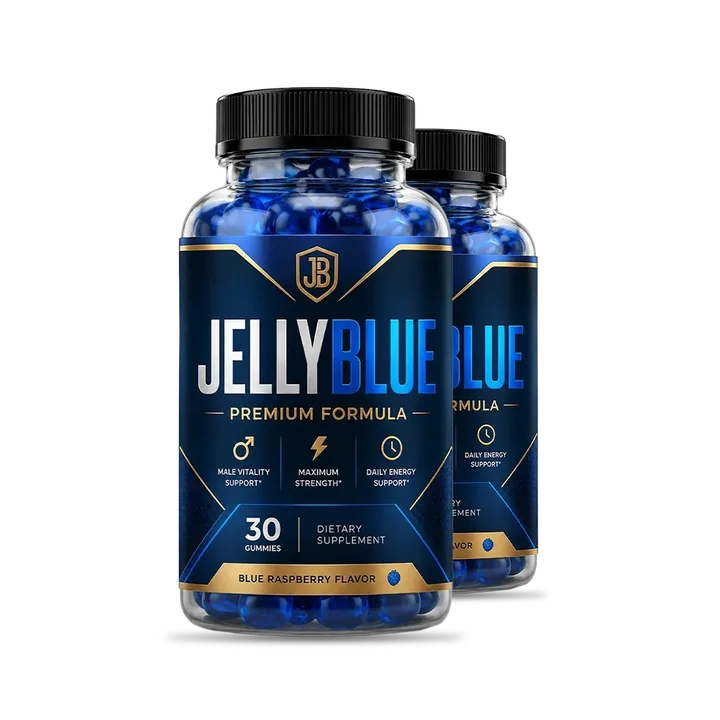
Order JellyBlue with the cautions read first
One narrow question if you take a nitrate, a blood thinner or a blood-pressure medicine. Otherwise a chewable a day, with sixty days from purchase to change your mind.
Two bottles $158 · three bottles $207 · 60-day money-back guarantee
Order JellyBlue On The Official Website30 gummies a bottle · lot JEL-26/JE-6782 · ships from the U.S.
Who publishes this JellyBlue website?
Every source cited in a caution above.
- Rehman SU, Choe K, Yoo HH. Review on a traditional herbal medicine, Eurycoma longifolia Jack (Tongkat Ali): its traditional uses, chemistry, evidence-based pharmacology and toxicology. Molecules. 2016;21(3):331. PMID 26978330. https://pubmed.ncbi.nlm.nih.gov/26978330/
- McIntyre D, Nguyen P, Kim Y, Meyer B, Salloum M. Ashwagandha (Withania somnifera)-associated liver injury: a scoping review of clinical characteristics and safety considerations. Cureus. 2026;18(5):e109764. PMID 42367407. https://pubmed.ncbi.nlm.nih.gov/42367407/
- Yong EL, Wong SP, Shen P, et al. Standardization and evaluation of botanical mixtures: lessons from a traditional Chinese herb, Epimedium, with oestrogenic properties. Novartis Found Symp. 2007;282:173-88. PMID 17913231. https://pubmed.ncbi.nlm.nih.gov/17913231/
- Benjamim CJR, Porto AA, Valenti VE, et al. Nitrate derived from beetroot juice lowers blood pressure in patients with arterial hypertension: a systematic review and meta-analysis. Front Nutr. 2022;9:823039. PMID 35369064. https://pubmed.ncbi.nlm.nih.gov/35369064/
- Zhang H, Liu S, Li L, et al. The impact of grape seed extract treatment on blood pressure changes: a meta-analysis of 16 randomized controlled trials. Medicine (Baltimore). 2016;95(33):e4247. PMID 27537554. https://pubmed.ncbi.nlm.nih.gov/27537554/
- U.S. Food and Drug Administration. Dietary Supplements. Accessed 21 September 2026. https://www.fda.gov/food/dietary-supplements
- National Center for Complementary and Integrative Health. Ashwagandha: usefulness and safety. Accessed 20 September 2026. https://www.nccih.nih.gov/health/ashwagandha