JellyBlue Official Website › Journal › The format
JournalHow Much Actually Fits In A Gummy
A capsule is a container and a gummy is a confection, which sets a hard ceiling of a few hundred milligrams of actives per piece. Ingredients studied in grams cannot fit; ingredients studied in hundreds of milligrams can. That single test sorts most of this aisle in about thirty seconds.
There is a question that decides more about a supplement than any ingredient list, and almost nobody asks it before buying: how much can this format actually hold?
It is not a rhetorical question. It has a physical answer, the answer is smaller than most people assume, and once you know it every gummy panel in every aisle starts to make sense.
The physical limit of a chewable
A capsule is a container. You fill a shell with powder, close it, and the only constraint is whether somebody can swallow it. A size 0 capsule takes something over half a gram of most powders; a size 00 takes closer to a gram. Nothing about the format cares what the powder tastes like.
A gummy is not a container. It is a confection, and the active material has to be dissolved or suspended in a matrix of sugar, glucose syrup, water and a gelling agent that must set properly, hold its shape for two years, survive a warm warehouse and taste acceptable enough that somebody eats one every morning.
Botanical extracts are bitter, astringent and often dark. They fight every one of those requirements. The practical ceiling before texture and flavour become a problem is a few hundred milligrams per piece, and formulators work hard to get there.
| Format | Typical actives per unit | What limits it | What it is good at |
|---|---|---|---|
| Hard capsule | 400-800 mg | Swallowability | Amount. Bitter material is invisible inside a shell. |
| Tablet | 500-1,500 mg | Compressibility and size | The largest amounts, and the least pleasant to take. |
| Gummy | 300-800 mg | Taste, texture and set | Adherence. People take them. |
| Powder or drink | 3-15 g | Palatability and preparation | Gram-scale ingredients, which is where arginine and nitrate live. |
| Softgel | 500-1,000 mg | Oil solubility | Fat-soluble material, which is not what this aisle mostly sells. |
Ranges are what is ordinarily achievable rather than absolute physical limits. The pattern matters more than the numbers.
What that means for a male vitality panel
The ingredients this category is built on are not evenly matched to the formats it uses, and that mismatch explains most of what a reader finds confusing about these labels.
L-arginine was studied at one and a half to five grams a day in the arms pooled by a network meta-analysis of supplement ingredients for erectile function. Maca was studied at one and a half to three grams (the 12-week maca trial in healthy men). Dietary nitrate is measured in millimoles and comes from vegetables or concentrate shots.
None of those three can be delivered at a studied amount by a chewable. Not by this one, not by any of them. A gummy that claims otherwise is either mis-stating its panel or asking you to eat a great many gummies.
Ashwagandha, by contrast, was studied at 240 to 600 mg (a randomised trial of ashwagandha in stressed adults, an eight-week ashwagandha trial in overweight men aged 40 to 70), and tongkat ali at 200 to 400 mg (a 2022 meta-analysis of tongkat ali trials). Those two fit a gummy, and on a well-designed chewable panel they would be most of the formula.
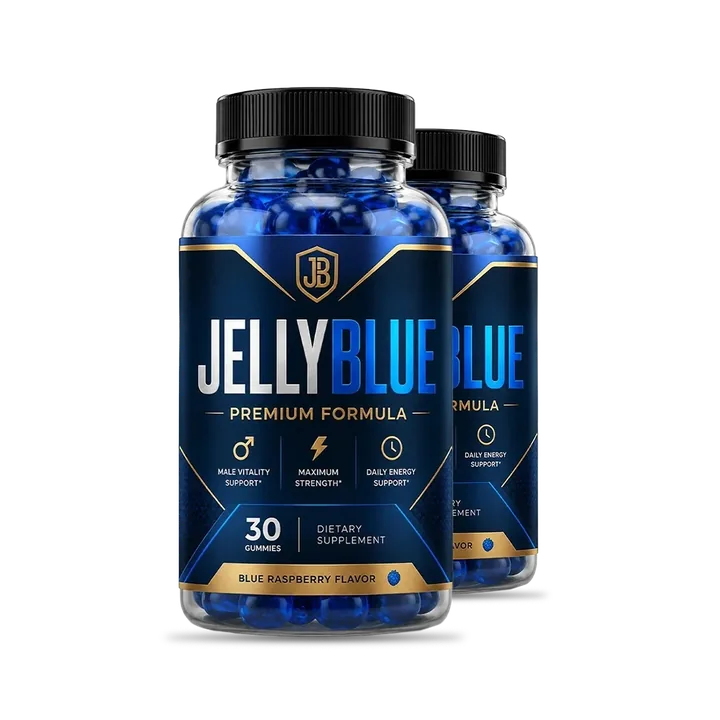
Order JellyBlue knowing what a gummy can and cannot carry
Seven actives, 650 mg in total, and a website that prints which of them fit the format and which are there to be named.
Two bottles $158 · three bottles $207 · 60-day money-back guarantee
Order JellyBlue On The Official Website30 gummies a bottle · lot JEL-26/JE-6782 · ships from the U.S.
So why do gummy panels carry seven ingredients?
Because a list sells and arithmetic does not.
A panel with seven names has seven chances to contain something a buyer has heard of. It photographs well on a listing image. It supports a longer ingredients section on the sales page. And because nobody is obliged to state an extract ratio, seven names at 50 to 200 mg each look, to an untrained eye, much like seven ingredients at useful amounts.
The alternative formulation is two or three ingredients at amounts the research used. It is a better product and a harder sell, and you can count on one hand the products in this aisle that take it.
This is not a conspiracy. It is what a market does when buyers reward the number of names on a label and cannot easily evaluate the numbers beside them.
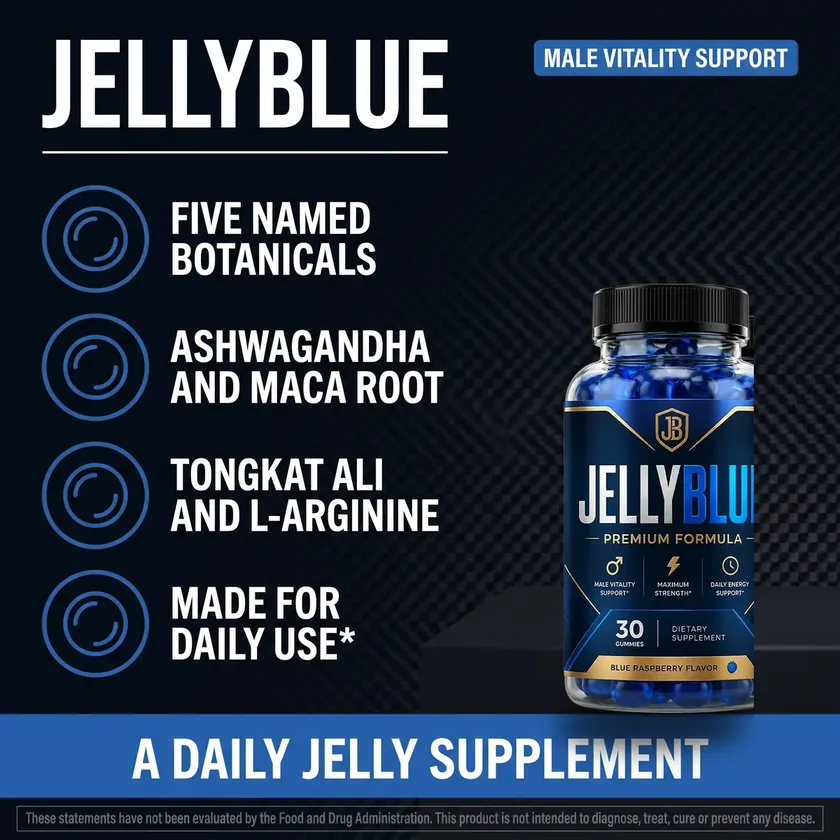
What the other ninety per cent of a gummy is
A gummy’s other-ingredients line is usually skipped, and it is the line that explains the format.
The one in front of this desk reads: cane sugar, glucose syrup, water, pectin, citric acid, sodium citrate, natural flavor, natural coloring, starch. Nine items, none of them active, and together they are the great majority of the piece by weight.
Sugar and glucose syrup are the body of the sweet. They are not there to make it pleasant so much as to make it a gummy at all: the sugar concentration is part of what gives the piece its texture and its shelf stability.
Pectin is the gel. It comes from fruit rather than from animal collagen, which is the single decision that makes a vegetarian gummy possible, and it sets differently from gelatin: firmer, with a cleaner bite and a shorter chew.
Citric acid and sodium citrate are an acid and its buffer. Pectin needs a particular acidity to set properly, and the same acidity carries a fruit flavour. That is why almost every pectin gummy tastes tart.
Flavour, colour and starch finish it: the first two cover the botanicals, the third stops the pieces welding together in the bottle.
Read that list and the trade-off is visible. Every one of those nine items is there to solve a problem created by making the product chewable, and the amount of room left for extract is what remains.
When a gummy is nevertheless the right answer
All of the above could be read as an argument against the format. It is not, and the case for a chewable is stronger than it looks.
Adherence beats amount, up to a point. A product taken every morning for three months at a small amount does more than a product taken for nine days at a large one, and the second scenario is what happens to a great many capsule bottles. The distributor’s five-star reviews say the same thing every time: daily habit stuck.
Two of the best ingredients in this category fit. Tongkat ali and ashwagandha are both gummy-sized. A chewable built around those two at trial amounts would be an excellent product.
Taste is a feature, not a weakness. It is the reason the bottle stays on the worktop instead of migrating to the back of a cupboard.
Three questions to ask any gummy label
Short, and they work in a shop aisle without a phone.
- What is the total active weight per piece? Add the panel up. Under about 200 mg and you are buying flavoured sugar with a garnish; 600 to 800 mg is near the practical ceiling of the format and is as much as anybody can do.
- How is that weight distributed? One ingredient at 400 mg is a formula. Eight at 50 mg each is a list. The distribution tells you more than the total.
- How much sugar comes with it? A gram and a half per piece is ordinary; four grams is a sweet. Multiply by thirty for the monthly figure, which is the one that actually affects anybody.
- And one bonus question: does the serving size say one gummy or two? A panel quoting amounts per two-gummy serving halves everything you just calculated, and a thirty-count bottle then lasts fifteen days.
A rule of thumb worth keeping
If an ingredient is studied in grams, it does not belong on a gummy panel and its presence there is decorative. If it is studied in hundreds of milligrams, a gummy can carry it and the question becomes whether this one does.
That single test sorts most of this aisle in about thirty seconds, and it is more useful than any badge on the front of a box. Apply it to the product this website sells and you get the same answer it gives elsewhere: two lines fit the format, five are there to be read.
It is worth saying what the rule does not do. It does not tell you that a product is bad, and it does not tell you that the five smaller lines are inert. Plenty of ingredients have never been tested at a low daily amount over six months, and absence of a trial is not evidence of absence of effect. What the rule tells you is what is known, and what is known is the only thing you can weigh against a price.
Knowing which is which before you buy is the entire difference between a considered purchase and a hopeful one. A hopeful purchase is not a scandal; it is simply a more expensive way of finding out the same thing.
- Barbonetti A, Tienforti D, Antolini F, et al., Nutraceutical interventions for erectile dysfunction: a systematic review and network meta-analysis · J Sex Med · 2024;21(11):1054-1063 · PubMed ID 39279185 · https://pubmed.ncbi.nlm.nih.gov/39279185/
- Gonzales GF, Córdova A, Vega K, et al., Effect of Lepidium meyenii (MACA) on sexual desire and its absent relationship with serum testosterone levels in adult healthy men · Andrologia · 2002;34(6):367-72 · PubMed ID 12472620 · https://pubmed.ncbi.nlm.nih.gov/12472620/
- Smith SJ, Lopresti AL, Fairchild TJ · Exploring the efficacy and safety of a novel standardized ashwagandha (Withania somnifera) root extract in adults experiencing high stress and fatigue in a randomized, double-blind, placebo-controlled trial · J Psychopharmacol · 2023;37(11):1091-1104 · PubMed ID 37740662 · https://pubmed.ncbi.nlm.nih.gov/37740662/
- Lopresti AL, Drummond PD, Smith SJ · A randomized, double-blind, placebo-controlled, crossover study examining the hormonal and vitality effects of ashwagandha (Withania somnifera) in aging, overweight males · Am J Mens Health · 2019;13(2):1557988319835985 · PubMed ID 30854916 · https://pubmed.ncbi.nlm.nih.gov/30854916/
- Leisegang K, Finelli R, Sikka SC, Panner Selvam MK · Eurycoma longifolia (Jack) improves serum total testosterone in men: a systematic review and meta-analysis of clinical trials · Medicina (Kaunas) · 2022;58(8):1047 · PubMed ID 36013514 · https://pubmed.ncbi.nlm.nih.gov/36013514/