JellyBlue Official Website › Journal › Reading a label
JournalSix Or Seven: Reading A Supplement Label Against Its Advert
A supplement box carries four or five separate documents written by different people, and they do not always agree. On the product examined here the advertising names six ingredients and the printed panel names seven. The regulated panel is the one that binds, and it takes about four minutes to read properly.
A supplement box is not one document. It is four or five, written by different people at different times for different purposes, and printed on the same piece of card.
Most of the time nobody notices, because they agree. When they do not, a buyer who knows which one binds gets a different answer from a buyer who does not, and the difference can be an entire ingredient.
The four documents on a supplement box
Learn to see them separately and reading a label becomes fast.
- The front panel. The brand, the form, the count, and usually two or three short claims. Regulated in the sense that the claims must be permissible, but written by whoever sells the product.
- The Supplement Facts panel. The regulated statement of contents: serving size, servings per container, each active with an amount, then the other-ingredients line. This is the one the manufacturer is answerable for.
- The caution and suggested-use block. How to take it, who should not, and storage. Short, boring and the most practically useful text on the box.
- The distributor block. Who put it on the market, and where. Usually the smallest print on the box and frequently a different company from the one whose website you bought it on.
- The sales page and the listing images. Not on the box at all, but they are what most people actually read before buying. These are advertising, and they are the ones most likely to be wrong.
A worked example: six or seven
The product this desk sells makes the point better than an invented example would, because its advertising and its panel give two different answers to the simplest question on the box.
| Where it is printed | What it says | What it lists |
|---|---|---|
| The seller’s sales page | six named ingredients | Tongkat ali, maca root, ashwagandha, horny goat weed, L-arginine HCl and grape seed extract. No amount against any of them, and no beet root. |
| The printed Supplement Facts panel | seven actives, with milligrams | The six above plus beet root extract at 50 mg, and a figure beside every one of them. This is the regulated statement on the container. |
The panel is the regulated statement on the container and the only one of the two carrying amounts, so where they disagree this website prints the panel.
Two surfaces, two answers. The panel is right, and the panel is the one almost nobody reads.
Notice also what the advertising gets right and what it leaves out. It names every ingredient that carries a story: tongkat ali, maca, ashwagandha, horny goat weed, L-arginine and grape seed. It omits the one whose story it does not tell. Beet root at 50 mg is not a secret; it is printed on the back of every bottle. It simply never made it into the sales copy, and a buyer who reads only the sales copy would never know it was there.
Notice too that the advertising puts no amount beside any of its six names. That is not unusual, and it is the second reason the panel wins: a list of names tells you what a product contains, and only a list of amounts tells you whether any of it matters. Six names with no numbers is a description of a formula. Seven lines with seven numbers is the formula.
| Document | Who writes it | How reliable | What to use it for |
|---|---|---|---|
| Supplement Facts panel | The manufacturer, in a prescribed format | The highest on the box | Everything: contents, amounts, serving size. |
| Caution and suggested use | The manufacturer | High | How to take it, who must not, how to store it. |
| Distributor block | The manufacturer | High | Working out which company answers which question. |
| Front panel claims | The seller, within the permitted set | Moderate | Understanding what is being sold, not what is inside. |
| Sales page and listing images | The seller's marketing | Lowest | Nothing, once you have the panel. |
Ordered by how much weight to put on each. The last row is the one shoppers spend the most time on.
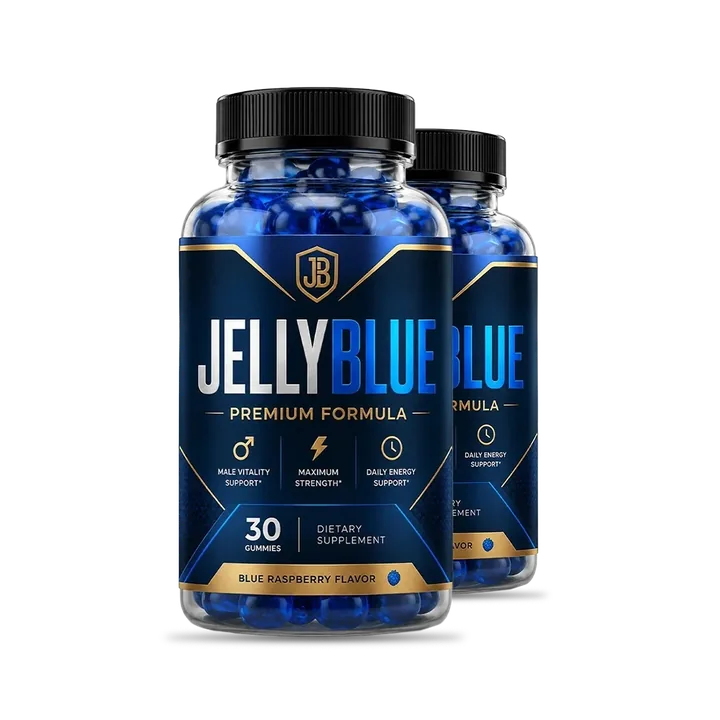
Order JellyBlue from a desk that prints the panel
Where the seller’s advertising and the printed panel disagree, this website prints the panel and shows the disagreement. Sixty days from the date of purchase.
Two bottles $158 · three bottles $207 · 60-day money-back guarantee
Order JellyBlue On The Official Website30 gummies a bottle · lot JEL-26/JE-6782 · ships from the U.S.
Why the panel is the one that binds
It is worth knowing why the back of a box outranks the front, because the answer is not that somebody checked it.
The FDA’s dietary supplements page is the agency’s own account of how these products are regulated, and the shape of it surprises most people. A dietary supplement is not reviewed or approved before it is sold. The manufacturer is responsible for establishing that its product is safe and that its labelling is truthful, and the agency acts afterwards if something goes wrong.
So the Supplement Facts panel is not a certificate. What it is, is the statement the manufacturer has formally made about the contents, in a prescribed format, on the container. It is the document that a regulator, a retailer or a lawyer would read, and it is the one the company is answerable for.
A sales page is not. It is advertising, it is governed by the general standard that advertising must not mislead, and nobody has ever filed one. The FTC’s rules on endorsements and testimonials cover the testimonials that sit beside it, and they are worth reading once for the same reason: they tell you what those quotes are and are not.
The practical rank order follows from that, and it is the reason the panel wins every argument on this website.
The four-minute method
Standing in a shop or looking at a listing, this is the order to do it in.
- Minute one. Find the Supplement Facts panel and read it top to bottom, including the other-ingredients line. Count the actives yourself.
- Minute two. Check the two or three largest amounts against what you know about their trials. If you do not know, note the names and look them up before buying.
- Minute three. Read the caution block. It tells you who must not take it and it is the fastest way to discover that a product is not for you.
- Minute four. Find the distributor block and the seller, and establish whether there is a telephone number and a returns address behind the guarantee on the front.
- Then, and only then, read the marketing. By that point you can tell which parts of it are supported by the panel and which are decoration.
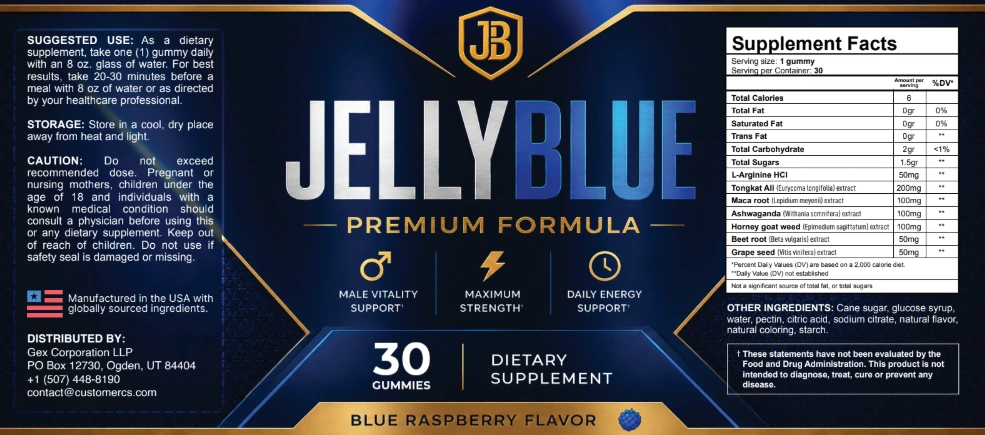
The block everybody skips
The distributor block deserves a paragraph of its own because it answers a question buyers only ask when something has gone wrong.
On this bottle it names Gex Corporation LLP of Ogden, Utah, with its own telephone number. The website you buy from is Jellybllue, a stocking partner in New York with a different address and a different number. Neither of those facts is hidden and neither is unusual: a great many supplements are formulated by one company, put on the market by a second and sold by a third.
What matters is knowing it before you need it. A formulation question goes to the distributor. An order, a refund or a tracking question goes to the desk that took your money. Ringing the wrong one costs a week.
Five other places a label contradicts itself
The ingredient count is the vivid one. There are five more worth looking for, and each of them turns up regularly across this aisle.
- Serving size against bottle count. A front panel saying “30 gummies” beside a panel whose amounts are per two-gummy serving is a fifteen-day bottle wearing a thirty-day label. Check the serving line before the amounts.
- The claims against the panel. A front panel claim implies an ingredient doing the work. If the ingredient that would do it is absent from the panel, or present at a trace, the claim is carried by nothing.
- The seals against the ingredients. A vegetarian mark on a gelatin gummy, a sugar-free badge above two grams of sugar. Both are quick to check and both do occur.
- The distributor against the seller. Two different companies in two different states is normal and worth noticing, because it tells you who can answer a formulation question and who can answer an order question.
- The count against the claim. A box promising a ninety-day supply that holds sixty pieces at two a day is arithmetic anyone can do in the shop, and it is done far less often than it should be.
What this habit is really worth
Four minutes per purchase, and it changes what you buy.
It will stop you paying for a proprietary blend that tells you nothing. It will show you when a front panel and a back panel disagree, which happens more often than it should. It will tell you who to ring. And it will occasionally turn up something genuinely interesting, like an ingredient sitting quietly on a panel that the people selling the product never mentioned.
The front of a box is written to be looked at. The back is written to be filed. Read the one that was filed.
- U.S. Food and Drug Administration · Dietary Supplements · retrieved 21 September 2026 · https://www.fda.gov/food/dietary-supplements
- U.S. Federal Trade Commission · Use of Endorsements and Testimonials in Advertising (16 CFR Part 255) · retrieved 21 September 2026 · https://www.ftc.gov/legal-library/browse/rules/use-endorsements-testimonials-advertising