JellyBlue Official Website › Journal › Testing it honestly
JournalThe First Six Weeks Of A Daily Supplement
Nothing on a botanical panel acts the same day, and the trials behind these ingredients measured at eight and twelve weeks. A fair test needs a written baseline, one variable at a time, thirty days of actual compliance and a verdict at the end rather than in the middle of the first bottle.
Almost every disappointed supplement review is a timing problem rather than a product problem. Somebody buys a bottle, takes it for nine days, feels nothing and writes three stars.
Sometimes the product deserves it. Usually the test that was run could not have produced an answer either way, and that is worth fixing, because a badly run test wastes the money twice.
Week one tells you nothing, and here is why
Nothing on a botanical panel acts the same day unless there is a stimulant on it. Caffeine, yohimbine and synephrine work within an hour; adaptogens and plant extracts do not, and a panel with none of the first three will produce nothing you can feel on a Tuesday afternoon.
The research says the same thing in its study designs, which are the most honest guide available to timescale. The ashwagandha trial in overweight men aged 40 to 70 measured its outcomes at eight weeks. The maca trial in healthy men reported its first change at week eight of a twelve-week run. The tongkat ali trial in older men ran for six months. Nobody designing a study of these ingredients expects to see anything in a fortnight, and they are the people with the strongest incentive to find something early.
What week one is actually for is finding out whether the product suits you: whether you can remember it, whether you like it, whether it upsets your stomach.
| Window | What can be known | What cannot | What to do |
|---|---|---|---|
| Days 1-7 | Whether you tolerate it and can remember it | Anything about effect | Establish the habit. Record nothing else. |
| Weeks 2-3 | Whether the habit has survived contact with real life | Still almost nothing about effect | Keep going. Do not form a verdict. |
| Weeks 3-6 | The first fair read | Whether it will hold | Compare against your written baseline. |
| Weeks 6-12 | A verdict worth acting on | Nothing much, by this point | Decide. Continue, stop, or change one variable and re-test. |
This is the shape of both the published trials and the distributor’s published reviews, which put the typical wait at three to six weeks.
The five minutes before the first dose
The single highest-value thing you can do with any supplement costs five minutes and happens before you take any of it: write down a baseline.
Without one you will compare week six against a memory of week zero, and memory is not neutral. It bends towards whatever you already believe, in both directions: a hopeful buyer remembers a worse baseline than they had, and a sceptical one remembers a better.
It does not need to be elaborate. Three numbers on the inside of a kitchen cupboard door will do.
- Sleep, out of ten, averaged over the last week as best you can.
- Energy at four in the afternoon, out of ten. Four o'clock rather than morning, because morning is mostly caffeine.
- Training sessions in the last fortnight, as a plain number.
- The date, which also anchors your refund window.
- One sentence about why you are buying it. This is the one people find uncomfortable later, and it is the most useful of the five.
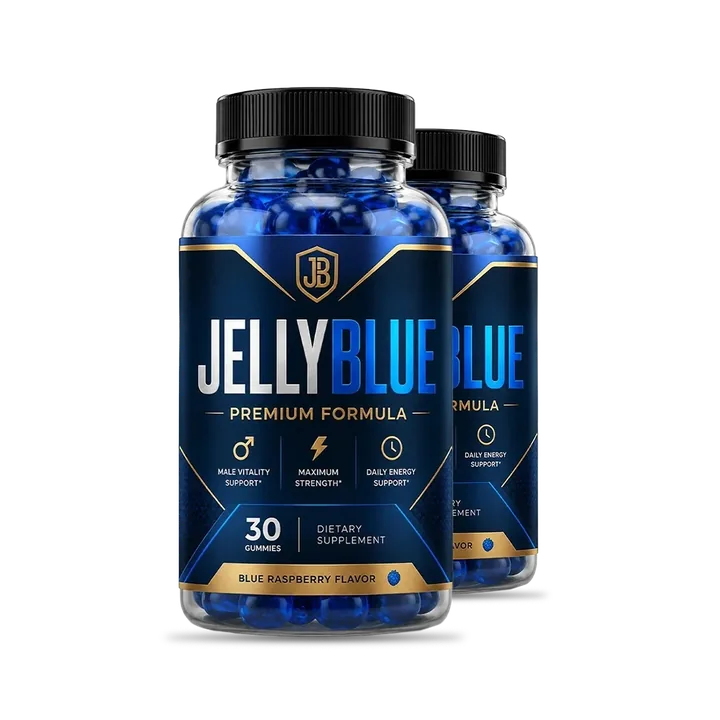
Order JellyBlue and run the test properly
Write the date on the bottle, take it at the same moment every day, and judge it at the end of the second bottle rather than in the middle of the first.
Two bottles $158 · three bottles $207 · 60-day money-back guarantee
Order JellyBlue On The Official Website30 gummies a bottle · lot JEL-26/JE-6782 · ships from the U.S.
Change one thing at a time
The second most common way to waste a supplement bottle is to start it in the same week as everything else.
A new gym membership, an earlier bedtime and a cut in drinking will each out-perform any gummy on this market. Start all four together and you will learn nothing about the fourth, in either direction: you will credit it with results it did not produce, or blame it for a plateau it had nothing to do with.
This is not a reason to avoid the other three. The NIH Office of Dietary Supplements factsheet on performance ingredients makes the same general point about supplements and the basics: the basics win. It is a reason to sequence them. Fix the sleep first, give it a month, then add the supplement if you still want to.
The placebo question, answered honestly
Somebody always asks, and the usual answers are both wrong. “It is all placebo” is not a finding; neither is “placebo does not matter if you feel better”.
Here is the useful version. Expectation genuinely moves self-rated outcomes, and self-rated outcomes are most of what this category measures: energy, drive, mood, how you slept. That is precisely why the trials behind these ingredients are placebo-controlled and why a trial without a control arm is close to worthless.
For an individual buyer, running a controlled trial on yourself is not practical. You cannot blind yourself to a blue raspberry gummy. What you can do is reduce the two biggest sources of self-deception, and both are free: write the baseline down before you start, and judge on a date you set in advance rather than on the day you happen to feel good.
There is also a straightforward test most people never run. Stop for two weeks at the end of the second bottle and see whether anything goes back. It is not blinded and it is not rigorous, and it is still the single most informative thing an individual can do with a supplement, because it reverses the direction of the expectation.
Reading your own result honestly
At the end of the second bottle, sit down with the baseline and ask four questions in this order.
- How many days did I actually take it? Thirty gummies is thirty days. If the bottle lasted forty-five, you ran a different test from the one on the label.
- What else changed? Be specific and be honest. A holiday, a deadline, a new job and a heatwave all move the same numbers.
- Is the difference bigger than the noise? Energy at four o'clock moves a point either way for reasons that have nothing to do with anything. A move from five to six is noise. Five to eight, sustained over three weeks, is not.
- Would I notice if I stopped? The most useful question of the four, and the only one you can test directly.
The awkward arithmetic of a sixty-day window
There is a tension worth naming between how long a fair test takes and how long a guarantee lasts, and almost no product page mentions it.
A 60-day window counted from the date of purchase and a fair test of three to six weeks are compatible, but not generously. A buyer who orders on the first, receives the parcel on the sixth, forgets about it for a week and starts on the thirteenth is at day fifty-five when six weeks of use are complete. That leaves five days to decide and post a parcel.
Three things fix it and all three are free. Start the bottle the day it arrives. Write the purchase date on the label rather than the delivery date. Put a reminder in your calendar for day fifty.
The window is counted from purchase rather than from delivery because purchase always comes first, which makes it the shorter and safer of the two counts. Work to the shorter one and you are never caught out.
What to do if the answer turns out to be no
Two bottles in, baseline in hand, and nothing has moved. This happens, it happens often, and what you do next matters more than the money involved.
- Check the compliance number first. If you took it on twenty of thirty days, you have not tested the product. That is worth knowing before concluding anything, and it is the most common explanation by a distance.
- Use the window rather than the cupboard. A refund window exists to be used. Half-finished bottles sitting in kitchens are the supplement industry’s quiet subsidy, and a desk that publishes a sixty-day policy expects some of it to be claimed.
- Do not immediately buy a different bottle. The failure mode here is serial purchasing: six products in a year, none tested properly, each abandoned at week three. One product tested properly beats six tested badly.
- Consider what the test actually told you. If two months of a botanical panel changed nothing, that is mild evidence that the thing bothering you is not in the range a supplement addresses, which is a useful result rather than a wasted one.
- And if something is genuinely wrong, get it looked at. New or persistent changes in function belong in front of a clinician rather than in a basket, and no supplement page should be the last stop on that road.
The honest summary
A daily supplement is a small intervention tested over a long period, and almost everything that goes wrong with one is a mismatch between those two facts and the expectations somebody brought to it.
Run it properly: a written baseline, one variable, thirty days of actual compliance, and a verdict at the end rather than in the middle. That is a real test, it costs nothing extra, and at the end of it you will know something.
Run it badly and you will have spent the money and learned nothing, which is the most common outcome in this entire market.
- Lopresti AL, Drummond PD, Smith SJ · A randomized, double-blind, placebo-controlled, crossover study examining the hormonal and vitality effects of ashwagandha (Withania somnifera) in aging, overweight males · Am J Mens Health · 2019;13(2):1557988319835985 · PubMed ID 30854916 · https://pubmed.ncbi.nlm.nih.gov/30854916/
- Gonzales GF, Córdova A, Vega K, et al., Effect of Lepidium meyenii (MACA) on sexual desire and its absent relationship with serum testosterone levels in adult healthy men · Andrologia · 2002;34(6):367-72 · PubMed ID 12472620 · https://pubmed.ncbi.nlm.nih.gov/12472620/
- Leitão AE, Vieira MCS, Pelegrini A, da Silva EL, Guimarães ACA · A 6-month, double-blind, placebo-controlled, randomized trial to evaluate the effect of Eurycoma longifolia (Tongkat Ali) and concurrent training on erectile function and testosterone levels in androgen deficiency of aging males (ADAM) · Maturitas · 2021;145:78-85 · PubMed ID 33541567 · https://pubmed.ncbi.nlm.nih.gov/33541567/
- National Institutes of Health, Office of Dietary Supplements · Dietary supplements for exercise and athletic performance: fact sheet for consumers · retrieved 20 September 2026 · https://ods.od.nih.gov/factsheets/ExerciseAndAthleticPerformance-Consumer/