JellyBlue Official Website › Journal › The missing ingredient
JournalJellyBlue Ingredients: The One That Never Made The Advert
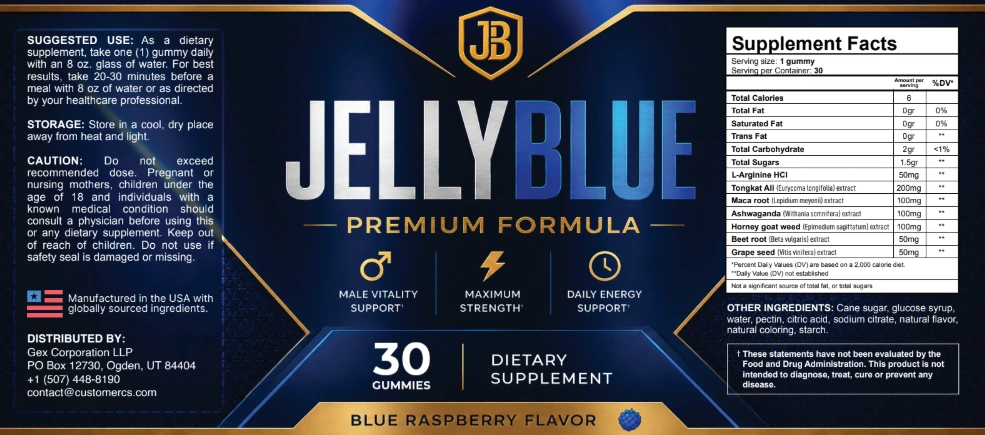
JellyBlue ingredients are seven actives printed on the Supplement Facts panel, 650 mg a gummy: tongkat ali at 200 mg, maca root, ashwagandha and horny goat weed at 100 mg each, and L-arginine HCl, beet root and grape seed at 50 mg each. The seller’s advertising names only six. The missing one is beet root, and dietary nitrate from beet has the best-measured human route to nitric oxide of anything on this label.
Turn a supplement bottle over and you are reading a different document from the one on the front. That is the whole point of a Supplement Facts panel: the front is advertising and the back is a regulated statement. Usually the two say roughly the same thing in different registers.
Occasionally they do not, and the gap is the most interesting thing on the label.
One ingredient, on the panel and nowhere else
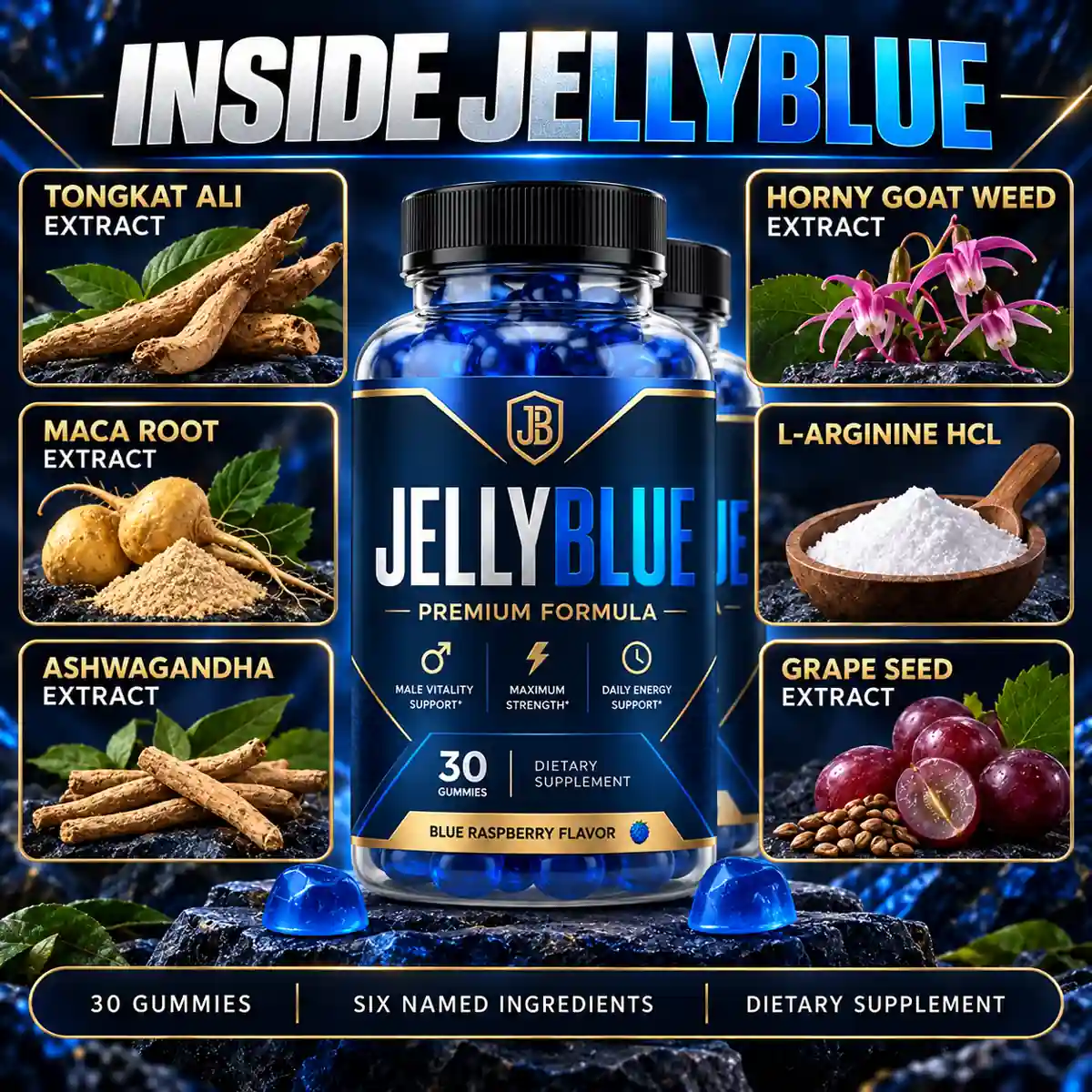
The product this desk sells names six ingredients on the seller’s sales page. Its printed panel names seven. The extra one is beet root extract, 50 mg, and it appears nowhere in the seller’s marketing at all.
A missing name on an advertisement is not normally worth a thousand words. This one is, because of which name it is.
Why beet root is the one you would least expect to lose
Almost every product in this category is sold on a nitric oxide story. Nitric oxide is a short-lived gas that signals the smooth muscle in blood-vessel walls to relax, and relaxed vessels carry more blood. That is genuinely how circulation works and it is not a marketing invention.
Where the marketing gets thin is in how the body is supposed to make more of it. The standard answer on a supplement label is L-arginine, the amino acid that nitric oxide synthase converts directly. It is a real pathway and it is a difficult one to exploit orally: the arms pooled in a network meta-analysis of supplement ingredients for erectile function, which covers this exact use case, run from one and a half to five grams a day, because most of what you swallow is metabolised before it gets anywhere.
There is a second route, and it is the one with the better human record. Dietary nitrate, the kind that occurs in beetroot and in green leafy vegetables, is turned into nitrite by microbes that live at the back of the tongue, and that nitrite becomes nitric oxide once it is in the bloodstream, most readily where oxygen is scarce. It bypasses the enzyme entirely.
The beetroot juice trial that opened this literature was published in 2008: 500 mL of beetroot juice, roughly 22.5 mmol of nitrate, and a measurable fall in blood pressure within hours. A meta-analysis of beetroot nitrate and blood pressure pools the trials that followed in people with raised blood pressure, and a 2026 meta-analysis of longer-term nitrate supplementation pools the longer-term ones.
What 50 mg of beet root extract is and is not
Now the part that keeps this honest. Fifty milligrams of a beet root extract is not 500 mL of juice, and nothing about the paragraphs above suggests it is.
The nitrate trials work in millimoles because nitrate is what is being measured. Beetroot juice concentrate shots are sold at 400 to 800 mg of nitrate a serving. A powdered beet extract of unstated concentration at 50 mg cannot reach that, and no label claiming otherwise should be believed.
So the interesting fact is not that this gummy delivers a nitrate dose. It is that the ingredient with the best-measured route to the exact end point the product is sold on is the one the advertising dropped, while the ingredient with the worst oral efficiency on the same pathway is the one it leans on.
| Route to nitric oxide | What the trials used | What a 650 mg gummy can hold | Practical verdict |
|---|---|---|---|
| L-arginine, via the enzyme | 1,500-5,000 mg/day | 50 mg here | A thirtieth of the lowest studied amount. |
| Dietary nitrate, via oral bacteria | 5-6 mmol/day, up to 22.5 in the first trial | 50 mg of extract here | Not reachable from an extract at this weight. |
| Vegetables, at dinner | One portion of rocket, spinach or beetroot | n/a | Reaches trial-scale nitrate for the price of a side salad. |
The third row is the one no supplement page prints, and it is the one that would change most readers' week.
Order JellyBlue with the panel read rather than the advert
Seven actives with a milligram against each, including the one the marketing leaves out. Sixty days from the date of purchase to change your mind.
Two bottles $158 · three bottles $207 · 60-day money-back guarantee
Order JellyBlue On The Official Website30 gummies a bottle · lot JEL-26/JE-6782 · ships from the U.S.
The part of the nitrate story nobody puts on a label
There is a detail in this literature that is genuinely useful and that no supplement manufacturer has any commercial reason to tell you.
The conversion from nitrate to nitrite happens because of bacteria living on the back of your tongue. They are part of the pathway, not a bystander. Antibacterial mouthwash reduces them, and in the experimental literature that blunts the blood-pressure effect of a nitrate load.
That is a striking thing about the best-evidenced route in this whole category: it depends on your oral microbiome, it can be undone by a bathroom habit, and it works at food doses rather than at supplement doses. None of which sells a bottle, which is presumably why none of it appears on one.
Why athletes found this before the vitality aisle did
Dietary nitrate did not arrive in supplement shops through the men’s health shelf. It arrived through sport, and the route is worth knowing because it explains what the ingredient is good at.
After the 2008 blood-pressure work, exercise physiologists noticed something unexpected: nitrate supplementation appeared to reduce the oxygen cost of submaximal exercise. That is a strange finding, because the oxygen cost of walking at a given speed had been treated as close to a physical constant. Cycling time trials, running economy and tolerance of high-intensity work all became subjects of nitrate trials, and beetroot juice concentrate became a fixture in professional sport.
The mechanism people settled on is the one that makes nitrate distinctive. The enzymatic route to nitric oxide, the one L-arginine feeds, needs oxygen to run. The nitrate-nitrite route works better as oxygen falls, which is exactly the condition inside a hard-working muscle and inside any tissue with restricted flow. The two pathways are complementary rather than redundant.
A 2026 meta-analysis of longer-term nitrate supplementation pools the longer-term blood-pressure trials, and the picture there is consistent: modest, real, and dependent on getting enough nitrate in. Which is the same sentence as ever.
What a buyer should actually do with this
Three things, and only the third of them involves buying anything.
- Read the panel, not the front. The front is written by a marketing department and the back is a regulated statement. Where they disagree, the back is the document that binds, and on this bottle they disagree by one ingredient.
- Eat the vegetables. If the nitric oxide story is what attracted you, the cheapest and best-evidenced version of it is a portion of rocket, spinach, beetroot or celery. That is not a joke at the expense of the product; it is what the trials actually used.
- Judge a supplement on the amounts you can see. On this panel that means tongkat ali at 200 mg, which is the one line inside its own trial range. The other six are smaller than the research, which is worth knowing before you buy rather than after.
How an ingredient falls off an advertisement
It is tempting to read an omission like this as concealment. It almost never is, and the ordinary explanation is duller and more useful.
A supplement is packaged by at least two groups of people. The formula and the Supplement Facts panel come from whoever develops and files the product, and the panel is a controlled document: changing it means changing the filing. The artwork and the sales page come from marketing, usually later, often from a brief rather than from the panel itself.
If that brief was written when the formula had six actives, and a seventh was added before launch, the panel gets updated and the brief does not. Everything downstream of the brief then inherits the old number, and a sales page that names six ingredients over a bottle that holds seven is exactly what that sequence would produce.
That is a quality-control failure rather than a deception, and for a buyer the consequence is identical either way. Whatever the reason, the front of the box is not a reliable description of the contents, and the back of the box is.
Why the gap matters more than the ingredient
Beet root at 50 mg will not change anybody’s month. What the omission shows is how these products get made: the panel is produced by whoever formulates and files the product, and the advertising is produced by whoever sells it, and the two do not always speak. For this product there are two separate statements of the contents and they say six and seven.
For a buyer that is a general lesson rather than a complaint about one brand. If the front of a box and the back of a box disagree about something as basic as how many ingredients are inside, then the front of the box is not a document you can use for anything, on any product, in any aisle.
Which is the whole argument for spending four minutes on the panel. It is the only part of the packaging that somebody was legally obliged to get right.
- Barbonetti A, Tienforti D, Antolini F, et al., Nutraceutical interventions for erectile dysfunction: a systematic review and network meta-analysis · J Sex Med · 2024;21(11):1054-1063 · PubMed ID 39279185 · https://pubmed.ncbi.nlm.nih.gov/39279185/
- Webb AJ, Patel N, Loukogeorgakis S, et al., Acute blood pressure lowering, vasoprotective, and antiplatelet properties of dietary nitrate via bioconversion to nitrite · Hypertension · 2008;51(3):784-90 · PubMed ID 18250365 · https://pubmed.ncbi.nlm.nih.gov/18250365/
- Benjamim CJR, Porto AA, Valenti VE, et al., Nitrate derived from beetroot juice lowers blood pressure in patients with arterial hypertension: a systematic review and meta-analysis · Front Nutr · 2022;9:823039 · PubMed ID 35369064 · https://pubmed.ncbi.nlm.nih.gov/35369064/
- Forster D, Waclawovsky G, Stefani GP · Effects of chronic nitrate supplementation on blood pressure in adults: a systematic review and meta-analysis of randomized clinical trials · Nutr Res · 2026;146:111-120 · PubMed ID 41619653 · https://pubmed.ncbi.nlm.nih.gov/41619653/