JellyBlue Official Website › Journal › What the instruments recorded
JournalWhat the Ashwagandha Trials Actually Measured
Ashwagandha sits on this panel at 100 mg inside a formula sold on vitality and drive. The five randomised trials behind the ingredient's best evidence did not measure either of those things. They measured perceived-stress scores, anxiety scales, morning cortisol and sleep quality — a real and repeatedly replicated effect, just not the one the shelf this gummy sits on is selling.
It is easy to read an ingredient list and assume every name on it was tested for the thing the product is sold on. That assumption is worth checking line by line, because the trials behind a botanical are usually designed around whatever question the researchers who ran them cared about, which is not always the question a marketing page later asks of the same ingredient.
What the panel says, and what it leaves for the marketing to imply
The printed panel lists “Ashwaganda extract, 100 mg” — the label's own spelling — with no withanolide percentage, no extraction ratio and no named proprietary form. It sits inside a seven-ingredient formula whose own marketing frames the whole product around male vitality and drive. Nothing on the panel itself claims ashwagandha does anything specific; the claim is carried entirely by the company the ingredient keeps on the label and in the product's positioning.
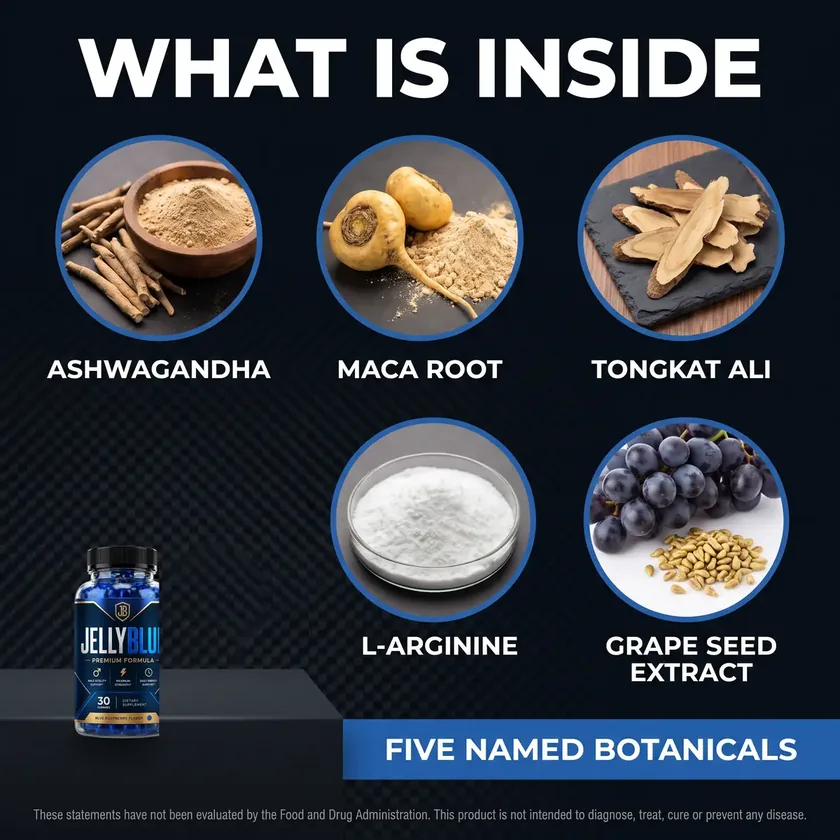
So the question worth asking is not whether ashwagandha “works.” It is what, specifically, the randomised evidence behind it has actually shown, measured with which instrument, in which population, at which dose. Five trials answer that question directly.
Five trials, one recurring set of instruments
Across five independent randomised, double-blind, placebo-controlled trials published between 2019 and 2026, the pattern is consistent enough to describe as a genre rather than a coincidence. Each recruited healthy adults with elevated self-reported stress, gave a standardised ashwagandha root extract for somewhere between eight and thirteen weeks, and measured some combination of a psychological stress or anxiety scale plus a blood marker, usually cortisol.
| Trial | Dose & duration | What it measured |
|---|---|---|
| Lopresti et al., 2019 | 240 mg/day, 60 days | HAM-A anxiety scale, DASS-21, morning cortisol, DHEA-S, testosterone |
| Salve et al., 2019 | 250 or 600 mg/day, 8 weeks | Perceived Stress Scale, HAM-A, serum cortisol, a seven-point sleep scale |
| Gopukumar et al., 2021 | 300 mg/day, 90 days | CANTAB memory battery, PSS-10, cortisol, Pittsburgh Sleep Quality Index, happiness score |
| West et al., 2026 | 600 mg/day, 8 weeks | Serum cortisol (primary), PSS, HAM-A, mood-states profile, happiness score |
| Arumugam et al., 2024 | Meta-analysis, 9 RCTs, 558 patients | Pooled PSS, Hamilton Anxiety Scale, serum cortisol |
Doses shown are the ashwagandha-extract arms tested; all five studies also included a placebo arm.
Not one of the five measured libido, sexual desire, erectile function or anything resembling the “vitality” framing a men's-health product typically borrows an adaptogen for. That is not a flaw in the trials — each was designed around a specific, pre-registered question about stress and anxiety, and each answered that question. It does mean the evidence sitting behind this line of the panel is not about the thing the shelf around it is selling.
Order JellyBlue
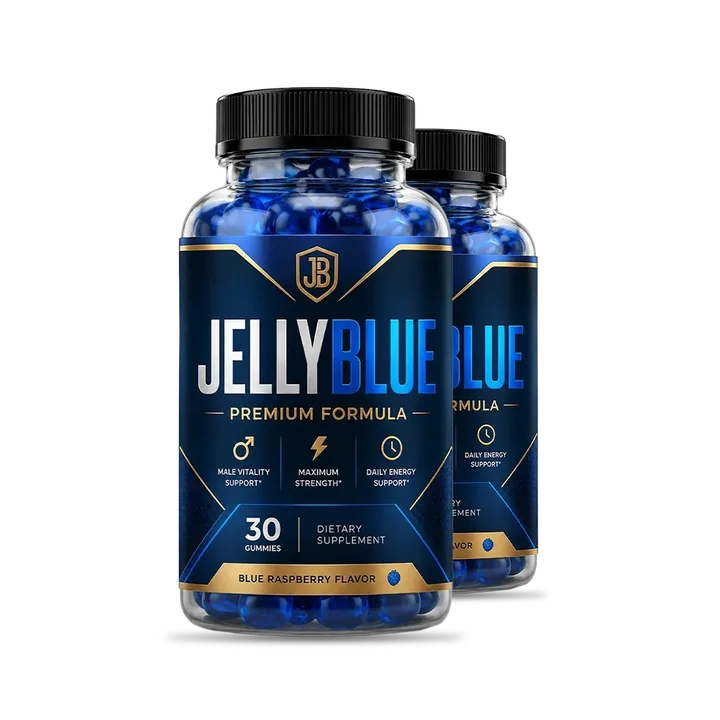
Seven actives with a milligram against each, ashwagandha included. What follows is exactly what its trial evidence does and does not show.
Two bottles $158 · three bottles $207 · 60-day money-back guarantee
Order JellyBlue30 gummies a bottle · ships from the U.S.
What “stress” meant, scale by scale
“Reduces stress” is doing a lot of work in supplement marketing generally, so it is worth being specific about the actual instruments these five trials used, because they are not interchangeable.
The Perceived Stress Scale (PSS), used in three of the five, is a short questionnaire asking how unpredictable, uncontrollable and overloaded a person has found their life over the past month — a subjective self-report, not a physiological measurement. Salve et al.'s 2019 trial found a significant PSS reduction at both 250 mg and 600 mg over eight weeks, alongside a matching drop in serum cortisol and better self-rated sleep. The Hamilton Anxiety Rating Scale (HAM-A), used in three trials including Lopresti et al.'s 2019 trial, is a clinician-administered interview scoring anxiety symptoms rather than a self-report, and it moved significantly too, at 240 mg over sixty days. Cortisol, the one objective blood marker common to four of the five trials, is a stress hormone and a reasonable biological correlate of both scales, but it is not itself a measure of energy, mood or libido; it can fall while a person's subjective experience changes very little, or move first and the questionnaire scores follow.
Cortisol moved reliably. Testosterone did not, in the one trial that checked
Only one of the five trials measured testosterone at all, and the result is a useful lesson in reading a study's own caveats rather than its headline. Lopresti et al. reported that testosterone “increased in males (P=.038) but not females (P=.989) over time, although this change was not statistically significant compared with the placebo” — meaning the men on ashwagandha saw a rise across the 60 days that was itself statistically real, but the placebo group moved in a similar enough direction that the difference between the two arms did not clear significance. That is precisely the distinction a marketing page tends to lose: a within-group change and a between-group, placebo-controlled result are different claims, and only the second one supports saying the ingredient did something the body would not have done anyway.
Cortisol and DHEA-S, by contrast, both dropped significantly more on ashwagandha than on placebo in the same trial, which is why the stress-hormone finding is the one that has replicated across the literature and the testosterone finding has not been chased further by the other four trials at all.
The distinction matters beyond this one trial, because every study in this set used a placebo arm that also improved. Stress and anxiety scales are unusually prone to a real, measurable placebo response — simply enrolling in a trial, filling out a questionnaire on a schedule and taking a capsule daily tends to lower a person's reported stress somewhat, independent of what is in the capsule. That is precisely why a within-group before-and-after number, on its own, is the weakest form of evidence in this literature, and why the placebo-controlled comparison is the number worth reading in each trial rather than the raw change from baseline.
The trial that measured something else entirely
Gopukumar et al.'s 2021 trial is the outlier worth knowing about, because its primary endpoint was not a stress scale at all. It used the Cambridge Neuropsychological Test Automated Battery (CANTAB), a computerised cognitive-testing system, and its main finding was improved recall memory and a lower error rate on a pattern-recall task after ninety days of 300 mg daily, alongside the now-familiar secondary drops in perceived stress, cortisol and better sleep-quality scores. That is a genuinely different claim — memory and recall, not mood or hormones — from a single trial that has not yet been independently replicated at this writing, which is the reason it belongs in this piece as one data point rather than as a settled finding.
What the 2024 meta-analysis adds across all of them
Arumugam et al.'s 2024 systematic review and meta-analysis pooled nine randomised trials and 558 patients specifically on stress and anxiety outcomes, and found significant effects favouring ashwagandha on the Perceived Stress Scale, the Hamilton Anxiety Scale and serum cortisol compared with placebo across the pooled data. That is the strongest single statement the evidence currently supports: a real, small-to-moderate, repeatedly measured effect on self-reported stress, clinician-rated anxiety and a cortisol biomarker, across multiple independent research groups. The same review also notes that roughly four of the trials it pooled reported mild to moderate adverse events, and that longer-term safety data remain limited — a caveat worth pairing with the side effects page's own note on ashwagandha and the liver.
The dose this panel doesn't reach
Every trial above used somewhere between 240 mg and 600 mg of a standardised extract daily. This panel prints 100 mg of an extract with no stated standardisation at all, which the ingredients page already flags as landing between two and a half and six times short of the studied range. Nothing about the endpoint question in this piece changes that arithmetic; if anything it sharpens it, because the specific effect the trials measured — a cortisol and perceived-stress reduction over eight to thirteen weeks — is the effect a lower, unstandardised dose has the least established claim to reproducing.
It is also worth being precise about what “standardised” means in the five trials themselves, because the panel's silence on it is the whole problem. Lopresti et al. used a proprietary extract standardised to a fixed withanolide glycoside content; Salve et al. and Gopukumar et al. each used a different named, standardised root-extract preparation. None of the five trials used raw root powder, and none used an extract described only as “ashwagandha extract” with no further specification, which is what this panel prints. A standardised 100 mg is a different, more defensible product than an unstandardised 100 mg of unknown withanolide content; this label does not say which one is in the bottle, so a reader cannot place it on the dose table above with any precision beyond the raw milligram figure.
What ashwagandha in this gummy is, and isn't, a claim about
Put together, the honest version of this ingredient's story is narrower than its shelf position implies and more solid than a skeptic might expect. Five independent randomised trials and a pooled meta-analysis have repeatedly found that a standardised ashwagandha extract, at 240 mg to 600 mg daily, lowers self-reported stress, clinician-rated anxiety and morning cortisol over eight to thirteen weeks, in healthy adults who started out stressed. One additional trial found a memory benefit that has not yet been independently repeated. None of the five measured libido, sexual desire or vitality, and the one trial that checked testosterone found no placebo-controlled difference.
A reader taking this gummy in the hope of calmer mornings and a lower resting stress level is standing on a body of evidence that, dose gap aside, several independent research groups have now reproduced. A reader taking it specifically for the ashwagandha line's contribution to the product's vitality claim is asking the ingredient a question none of its own trials were built to answer — which is the same distinction the journal's piece on testing a daily supplement honestly makes about the product as a whole: know what you are actually measuring before you decide whether it worked.
- Lopresti AL, Smith SJ, Malvi H, Kodgule R. An investigation into the stress-relieving and pharmacological actions of an ashwagandha (Withania somnifera) extract: A randomized, double-blind, placebo-controlled study. Medicine (Baltimore). 2019;98(37):e17186. PMID 31517876. https://pubmed.ncbi.nlm.nih.gov/31517876/
- Salve J, Pate S, Debnath K, Langade D. Adaptogenic and Anxiolytic Effects of Ashwagandha Root Extract in Healthy Adults: A Double-blind, Randomized, Placebo-controlled Clinical Study. Cureus. 2019;11(12):e6466. PMID 32021735. https://pubmed.ncbi.nlm.nih.gov/32021735/
- Gopukumar K, Thanawala S, Somepalli V, Rao TSS, Thamatam VB, Chauhan S. Efficacy and Safety of Ashwagandha Root Extract on Cognitive Functions in Healthy, Stressed Adults: A Randomized, Double-Blind, Placebo-Controlled Study. Evid Based Complement Alternat Med. 2021;2021:8254344. PMID 34858513. https://pubmed.ncbi.nlm.nih.gov/34858513/
- West RE, Biswas A, Rao R, Tayade H, Ademola J. A proprietary herbal extract of ashwagandha root for stress and anxiety in healthy adults: a randomized, double-blind, three-arm, placebo-controlled efficacy and safety study. J Med Life. 2026;19(1):49-62. PMID 41815853. https://pubmed.ncbi.nlm.nih.gov/41815853/
- Arumugam V, Vijayakumar V, Balakrishnan A, et al. Effects of Ashwagandha (Withania Somnifera) on stress and anxiety: A systematic review and meta-analysis. Explore (NY). 2024;20(6):103062. PMID 39348746. https://pubmed.ncbi.nlm.nih.gov/39348746/