JellyBlue Official Website › Journal › Who should not take it
JournalWho Should Not Take JellyBlue: The Interactions the Label Doesn't Spell Out
The printed caution says to ask a physician if you have “a known medical condition.” That is honest but not specific. Three of the seven actives on this panel touch the same nitric-oxide or clotting pathways that some prescription drugs are built around, and one nudges a hormone a fourth medicine is titrated against. This is the mechanism behind each of those, in enough detail to make the doctor's-office conversation short.
A back label has to say something to everyone, which is why the printed caution on this bottle reads the way most supplement cautions read: pregnancy, nursing, under 18, and then “individuals with a known medical condition should consult a physician.” That line is legally sufficient and practically useless, because it names no condition and no mechanism. A reader who actually takes a prescription has no way to tell, from that sentence alone, whether their situation is the one it is warning about.
It usually is not. Most people on most medications can take most gummies without anything happening. But four of the seven lines on this panel have a specific, nameable reason a clinician might want to know about them, and the reasons are worth setting out once, with the studies behind each one, rather than folded into a single generic sentence.
A caution that names no drugs
Start with what the panel and the rest of this website already say, because the groundwork is not new. The side effects page flags nitrates, blood thinners and blood-pressure medicines as the interaction “worth a specific conversation,” and names beet root, grape seed and horny goat weed as the three ingredients behind it. That is the right shortlist. What follows here is the mechanism underneath each item on it, plus two more that the same shortlist does not currently spell out: what ashwagandha does to a thyroid panel, and what a phytoandrogenic botanical implies for a man managing a hormone-sensitive condition.
Beet root's nitrate and a prescribed nitrate
Beet root extract sits on this panel at 50 mg, and its route to an effect is dietary nitrate: reduced to nitrite by bacteria in the mouth, then to nitric oxide once it reaches the bloodstream. That is the same signalling molecule, arrived at by the same chemistry, that a prescribed nitrate medicine — glyceryl trinitrate, isosorbide mononitrate or isosorbide dinitrate, typically prescribed for angina — is designed to deliver directly and in a controlled dose.
Prescribed nitrates already carry a well-known, decades-old contraindication with phosphodiesterase type 5 (PDE5) inhibitors such as sildenafil and tadalafil, because both raise cyclic GMP through the same pathway and the combination can drop blood pressure sharply; the pharmacology of that interaction is summarised in a clinical review of PDE5 inhibitors in erectile dysfunction and cardiovascular disease. A food-derived nitrate at 50 mg of extract is a much smaller nudge on the same dial than a prescribed dose, and it is not a reason to panic. It is a reason to mention the gummy at the next visit if a nitrate medicine is already part of the picture, because the person titrating that prescription is the one positioned to say whether the margin matters for a specific patient.
The panel's other route to the same enzyme
The nitrate pathway is not the only place on this label that touches cyclic GMP. Horny goat weed, printed at 100 mg, carries icariin, the compound the plant is known for, and icariin has its own laboratory record of acting on phosphodiesterase type 5 directly — the same enzyme sildenafil inhibits.
An early tissue study, Jiang et al.'s 2006 work on icariin and PDE5 expression in penile cavernosum, incubated rabbit corpus cavernosum with icariin alongside sildenafil for comparison and found icariin raised cyclic GMP directly and suppressed PDE5 messenger RNA, with a weaker potency than sildenafil but the same direction of effect. A related study, Zhang et al.'s work on the icariin derivative Icarisid II, measured the same cyclic-GMP rise in diabetic rat tissue and again used sildenafil as the comparator. A third, Lan et al.'s 2018 study of an icariin derivative in pulmonary hypertension, found the compound reduced pulmonary artery pressure through the same nitric-oxide/cyclic-GMP route PDE5 inhibitors use, again in a rodent model.
None of these are human interaction studies, and none tested icariin against a prescribed PDE5 inhibitor in a person. What they establish is mechanism: this ingredient, independent of the beet root line entirely, acts on the identical enzyme system a prescribed erectile-dysfunction or pulmonary-hypertension medicine targets. Two ingredients in one gummy, each nudging the same pathway from a different starting point, is worth knowing about even where neither one alone would be.
Order JellyBlue
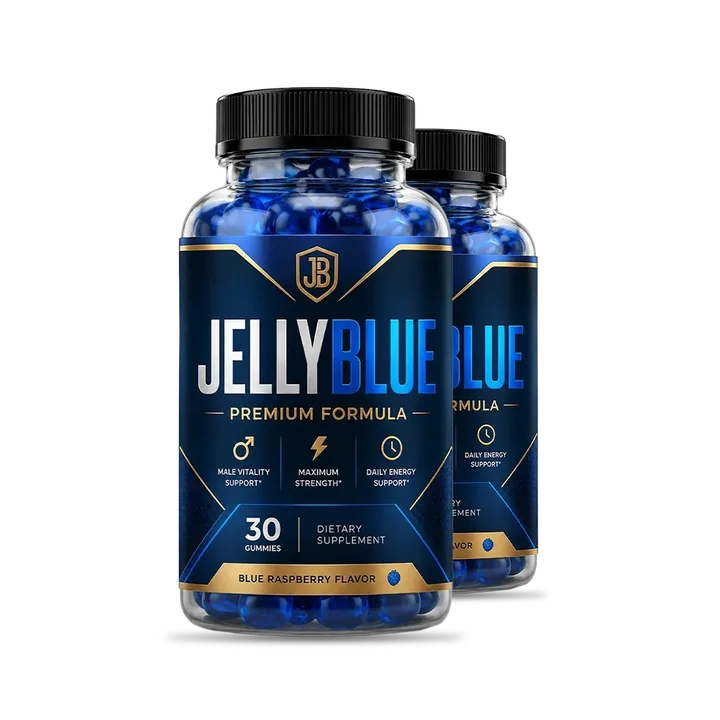
Seven actives with a milligram against each, printed panel first. Read the cautions below before the first gummy if a prescription is already part of your routine.
Two bottles $158 · three bottles $207 · 60-day money-back guarantee
Order JellyBlue30 gummies a bottle · ships from the U.S.
Grape seed and the clotting you don't see
Grape seed extract is the last and smallest line on the panel at 50 mg, usually described on supplement pages in terms of blood pressure or vascular tone. It has a second property that gets mentioned far less often: in vitro anticoagulant and antiplatelet activity.
A 2019 laboratory study of polyphenolic grape seed extract measured its effect on coagulation time, thromboelastometry and platelet aggregation directly, and found the extract reduced ADP-induced platelet aggregation and lengthened clotting time in a dose-dependent way, concluding the extract has “dual anticoagulant/antiplatelet activity.” That study used concentrations applied directly to blood in a test tube, not a dose taken by mouth, so it does not tell you what 50 mg of an oral extract does to a person's clotting time. It does tell you the mechanism is real and measurable, which is the reason grape seed sits on the same interaction shortlist as beet root and horny goat weed on this website's side effects page: anyone on a blood thinner or antiplatelet medicine, where the margin between too little and too much is managed deliberately, has a specific reason to mention this ingredient rather than a generic one.
Ashwagandha and a thyroid number somebody is managing
Ashwagandha, printed as “Ashwaganda” at 100 mg, has a different kind of interaction: not with a drug's mechanism directly, but with a number a drug is prescribed to control.
Sharma et al.'s 2018 randomised trial in subclinical hypothyroid patients gave 600 mg of ashwagandha root extract daily for eight weeks and found it moved serum TSH, T3 and T4 significantly toward normal ranges compared with placebo. That is a favourable result for the population it studied, and it is also the reason the interaction exists: ashwagandha measurably changes thyroid hormone levels at 600 mg, in people whose levels were already elevated. Anyone on levothyroxine or another thyroid medicine has their dose titrated to a specific TSH target through regular blood draws, and an ingredient capable of moving that number is worth mentioning at the next test even at a sixth of the studied amount, so a change in bloodwork gets attributed correctly rather than treated as a dosing problem with the prescription itself.
Tongkat ali and the caution that travels with any androgen-raising botanical
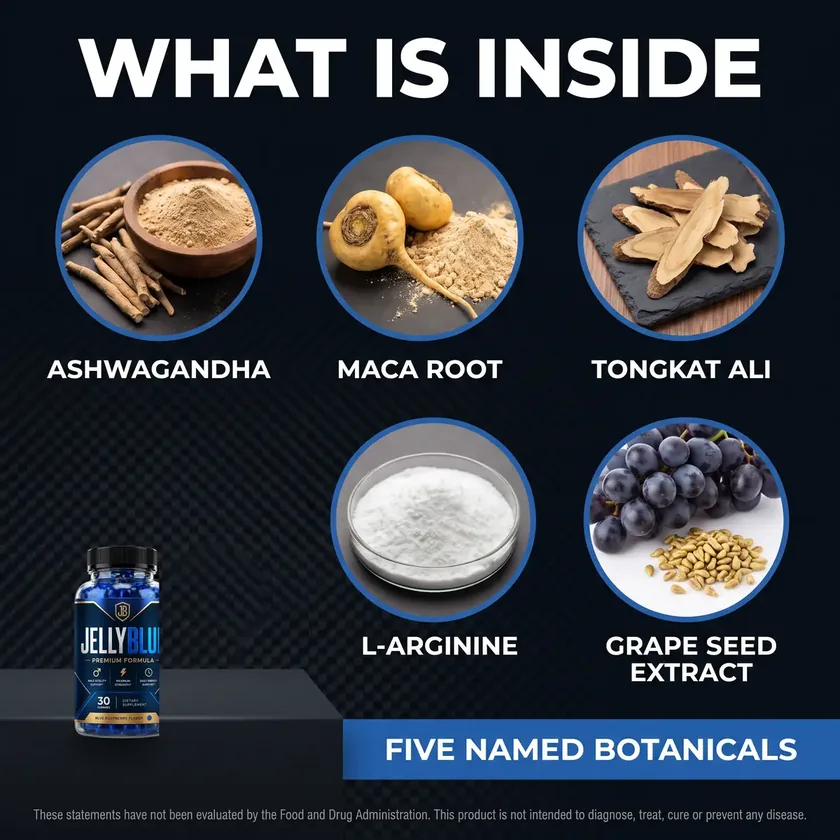
Tongkat ali, the largest single line on the panel at 200 mg, is marketed across this category as a testosterone-support botanical, and the pharmacology literature broadly agrees that it has phytoandrogenic activity. George and Henkel's 2014 review of Eurycoma longifolia as a natural alternative to testosterone replacement therapy describes the plant as capable of restoring serum testosterone in men with age-related decline, and in the same paragraph notes that prostate cancer is treated as an “absolute contraindication” debated for conventional testosterone replacement therapy itself.
That caution belongs to testosterone replacement therapy, a prescribed treatment at doses and delivery routes nothing like a 200 mg gummy extract, and it would be wrong to import it wholesale. What is fair to carry across is the underlying logic: any ingredient with a credible mechanism for raising androgen activity is one a man with a personal or family history of prostate cancer, or any other hormone-sensitive condition, has a specific and legitimate reason to raise with his own physician before adding it to a daily routine, rather than assuming a botanical origin makes the question moot. The journal's separate piece on this ingredient's dose covers what 200 mg does and does not reproduce from the trials; this section covers the mechanism the dose sits on top of.
The one question, asked in full
Put together, four of the seven lines on this panel carry a distinct, nameable interaction logic rather than a generic caution:
| Ingredient | Pathway | Who has a specific reason to ask first |
|---|---|---|
| Beet root, 50 mg | Dietary nitrate → nitrite → nitric oxide | Anyone on a prescribed nitrate or a PDE5 inhibitor |
| Horny goat weed, 100 mg | Icariin acting directly on PDE5 | The same two groups, by a separate route |
| Grape seed, 50 mg | Antiplatelet / anticoagulant activity in vitro | Anyone on a blood thinner or antiplatelet medicine |
| Ashwagandha, 100 mg | Measured shift in TSH, T3, T4 at higher doses | Anyone on thyroid medication with a managed target |
| Tongkat ali, 200 mg | Phytoandrogenic activity | Anyone with a hormone-sensitive condition |
Mechanism, not measured human interaction, in every row except the ashwagandha/thyroid line, which is a direct randomised finding.
That table is also the fastest way to have the conversation a printed caution can't have for you. “I'm taking a daily gummy with beet root, horny goat weed, grape seed, ashwagandha and tongkat ali at these amounts, alongside [medicine] — is there anything you'd rather I didn't?” is a specific, answerable question. A pharmacist or physician can act on it in the time it takes to read this paragraph, which a generic “consult a physician” line cannot do on its own.
What this list is not
None of this is a claim that JellyBlue is dangerous, or that these five ingredients cannot coexist safely with the medicines named above in the great majority of cases. Most of the studies behind this piece are laboratory or animal work establishing mechanism, not clinical trials measuring what happens when a person on a specific prescription takes a specific gummy; the one exception, the ashwagandha-and-thyroid trial, is a favourable result in the population it studied, not a warning by itself.
What the list is is the missing middle step between a printed line that says “consult a physician” and an actual conversation. A reader who is not on any of the medicine classes above has, in a meaningful sense, already had this conversation by reading this far. A reader who is on one of them now has a specific, three-sentence question to bring to whoever manages that prescription, which is a considerably better position than the label alone puts anyone in.
- Ravipati G, McClung JA, Aronow WS, Peterson SJ, Frishman WH. Type 5 phosphodiesterase inhibitors in the treatment of erectile dysfunction and cardiovascular disease. Cardiol Rev. 2007;15(2):76-86. PMID 17303994. https://pubmed.ncbi.nlm.nih.gov/17303994/
- Jiang Z, Hu B, Wang J, Tang Q, Tan Y, Xiang J, Liu J. Effect of icariin on cyclic GMP levels and on the mRNA expression of cGMP-binding cGMP-specific phosphodiesterase (PDE5) in penile cavernosum. J Huazhong Univ Sci Technolog Med Sci. 2006;26(4):460-2. PMID 17120748. https://pubmed.ncbi.nlm.nih.gov/17120748/
- Zhang J, Wang YB, Ma CG, Liu T, Li WR, Gong YQ, Xin ZC. Icarisid II, a PDE5 inhibitor from Epimedium wanshanense, increases cellular cGMP by enhancing NOS in diabetic ED rats corpus cavernosum tissue. Andrologia. 2012;44 Suppl 1:87-93. PMID 21729132. https://pubmed.ncbi.nlm.nih.gov/21729132/
- Lan TH, Chen XL, Wu YS, Qiu HL, Li JZ, Ruan XM, Xu DP, Lin DQ. 3,7-Bis(2-hydroxyethyl)icaritin, a potent inhibitor of phosphodiesterase-5, prevents monocrotaline-induced pulmonary arterial hypertension via NO/cGMP activation in rats. Eur J Pharmacol. 2018;829:102-111. PMID 29665366. https://pubmed.ncbi.nlm.nih.gov/29665366/
- Bijak M, Sut A, Kosiorek A, Saluk-Bijak J, Golanski J. Dual Anticoagulant/Antiplatelet Activity of Polyphenolic Grape Seeds Extract. Nutrients. 2019;11(1):93. PMID 30621248. https://pubmed.ncbi.nlm.nih.gov/30621248/
- Sharma AK, Basu I, Singh S. Efficacy and Safety of Ashwagandha Root Extract in Subclinical Hypothyroid Patients: A Double-Blind, Randomized Placebo-Controlled Trial. J Altern Complement Med. 2018;24(3):243-248. PMID 28829155. https://pubmed.ncbi.nlm.nih.gov/28829155/
- George A, Henkel R. Phytoandrogenic properties of Eurycoma longifolia as natural alternative to testosterone replacement therapy. Andrologia. 2014;46(7):708-21. PMID 24386995. https://pubmed.ncbi.nlm.nih.gov/24386995/