JellyBlue Official Website: Male Vitality Gummies with Tongkat Ali 200 mg
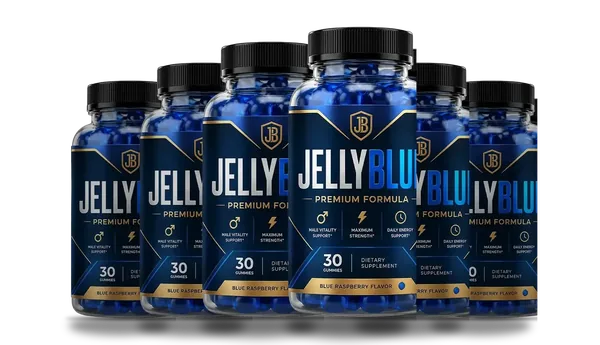
JellyBlue is a chewable blue raspberry gummy for male vitality support, one a day, thirty to a bottle.
Its printed panel names seven actives with a milligram against each: tongkat ali 200 mg, maca, ashwagandha and horny goat weed at 100 mg, then L-arginine, beet root and grape seed at 50 mg. The advertising names six. Packs run $158 to $294 behind a 60-day window.
Below: the panel transcribed row for row, each amount set beside the amount its trials used, the ingredient the marketing drops, what the three tiers cost, what the distributor’s 901 published reviews say, and how the 60 days are counted.
- 30 gummies a bottle
- 650 mg of actives a gummy
- 3-6 weeks typical wait
- Blue raspberry chewable
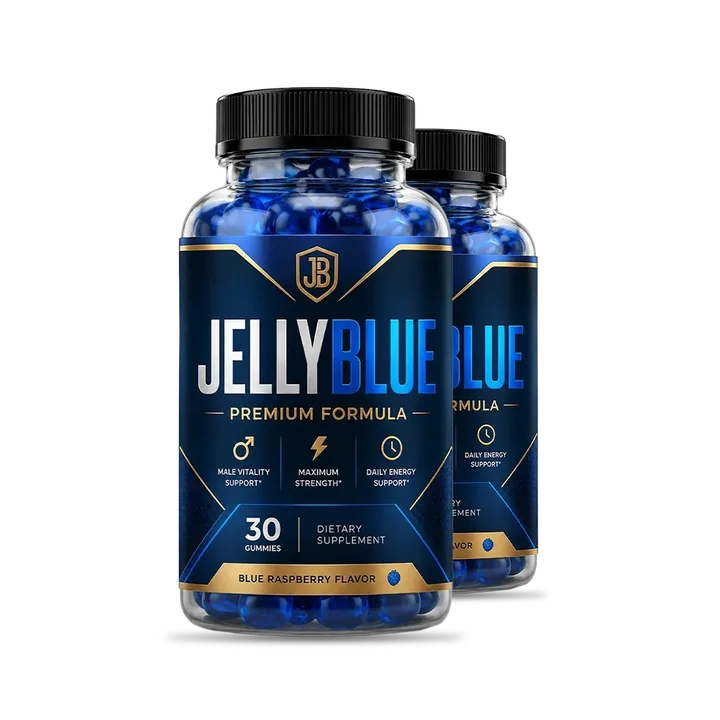
Lot JEL-26/JE-6782 · 30 gummies a bottle · front labels as shipped
What JellyBlue is, in the words printed on the bottle
The claim ceiling for this whole website, set by the front panel.
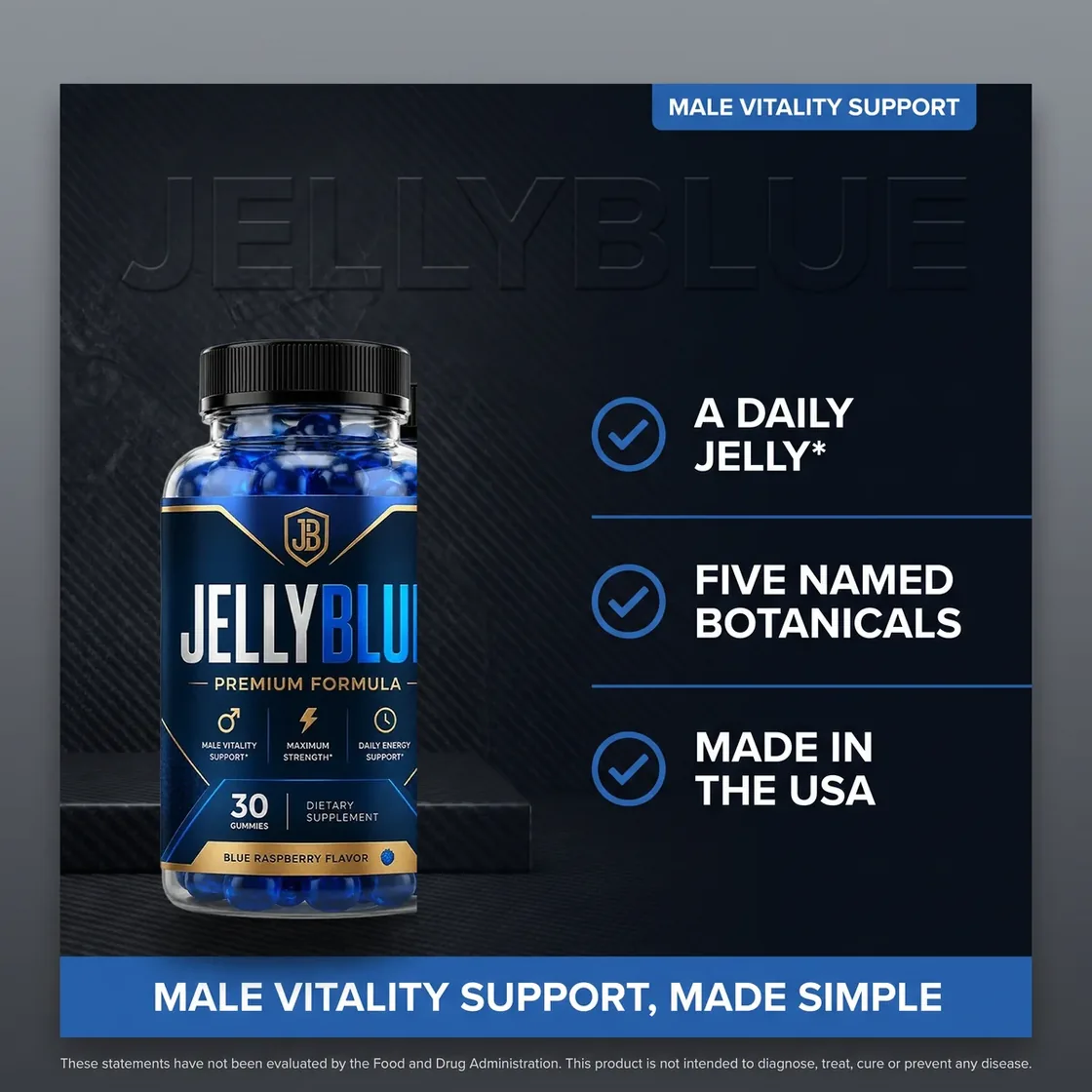
Three claims are printed on the front of this bottle and they are the whole of what it says about itself: male vitality support, maximum strength and daily energy support. Those three phrases are the ceiling on everything written on this website. Where the seller’s own page goes further, and in places it goes a long way further, this desk stays with the bottle. The back label adds one more fact worth having: manufactured in the USA with globally sourced ingredients.
Underneath them the panel states the form: 30 gummies, dietary supplement, blue raspberry flavour. It is chewed, not swallowed. One a day with a glass of water, ideally twenty to thirty minutes before a meal. Thirty gummies is thirty days, which is why the seller counts its packs in sixty, ninety and a hundred and eighty days rather than in bottles.
A gummy carries 650 mg of named actives, six calories, two grams of carbohydrate and one and a half grams of sugar. The sweetness is cane sugar and glucose syrup, which head the other-ingredients list; the blue is natural colouring. Over a full bottle that is roughly forty-five grams of sugar spread across a month, or about one regular soft drink.
Jellybllue is the U.S. stocking partner for JellyBlue, not its manufacturer. The back panel names Gex Corporation LLP of Ogden, Utah as the distributor; the desk that takes your order, your tracking question and your refund is in New York on +1 (302) 200-3480. Two companies, two jobs, both printed here so nobody has to guess which one to ring.
What is inside JellyBlue: six ingredients or seven?
This is the first thing worth checking on any supplement and on this one it is unusually interesting, because the product answers the question twice and gives two different answers. The seller’s sales page is advertising; the Supplement Facts panel is the regulated statement printed on the container you receive.
| Where it is printed | What it says | What it lists |
|---|---|---|
| The seller’s sales page | six named ingredients | Tongkat ali, maca root, ashwagandha, horny goat weed, L-arginine HCl and grape seed extract. No amount against any of them, and no beet root. |
| The printed Supplement Facts panel | seven actives, with milligrams | The six above plus beet root extract at 50 mg, and a figure beside every one of them. This is the regulated statement on the container. |
The panel is the regulated statement on the container and the only one of the two carrying amounts, so where they disagree this website prints the panel.
The gap between six and seven is beet root extract, 50 mg. It is on the panel and it is nowhere on the seller’s sales or order page. That is worth a paragraph rather than a footnote, because beet root is not a filler. Beet nitrate is turned into nitrite by microbes that live at the back of the tongue, and that nitrite becomes nitric oxide once it is in the bloodstream. The route has been measured in people more times than anything else on this label, starting with the beetroot juice trial that opened this literature.
So the ingredient the marketing department dropped is the one with the clearest human mechanism for the thing the marketing department is selling. For its blood-flow story the advertising leans instead on L-arginine, which reaches the same nitric oxide by a different and much less efficient route, and does so here at 50 mg.
Counted properly, the panel holds six botanicals and one amino acid. The illustrations below picture the headline names; they are pictures rather than lists, and a badge on an illustration is not a count to rely on. Only the panel carries every line with an amount against it.
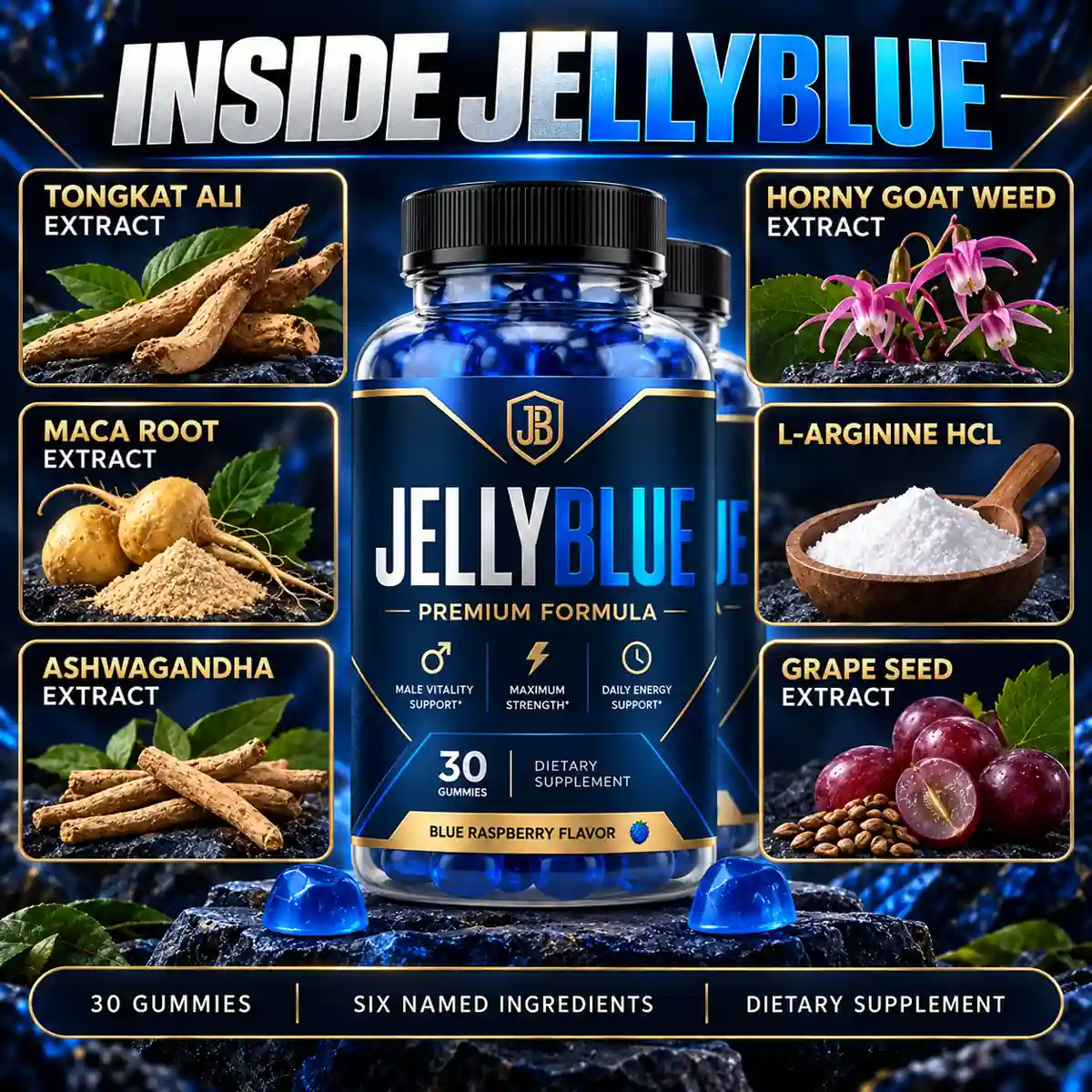
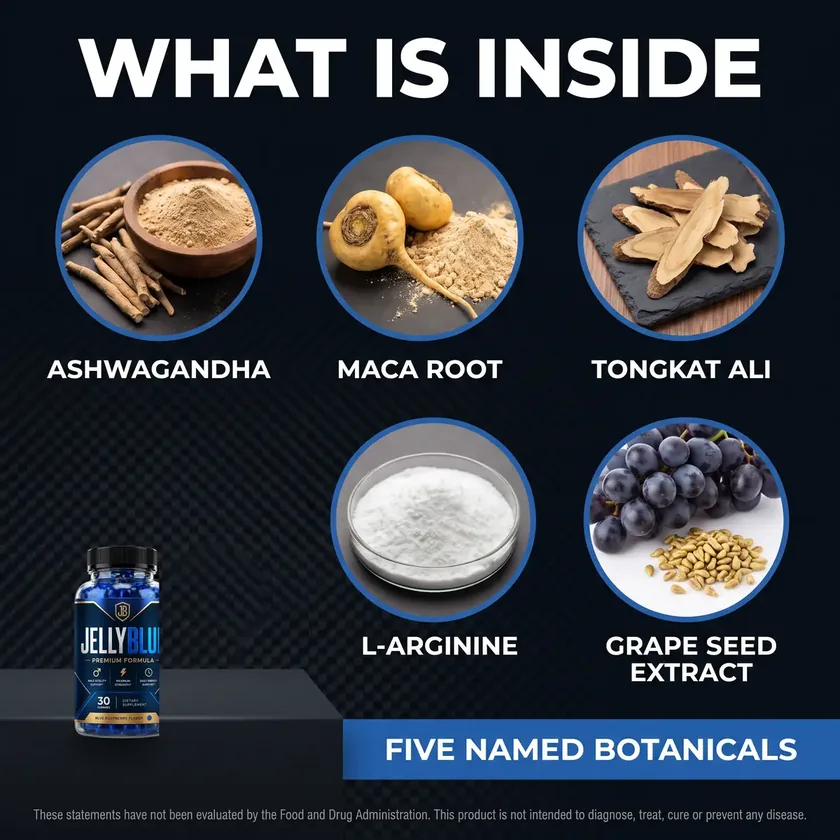
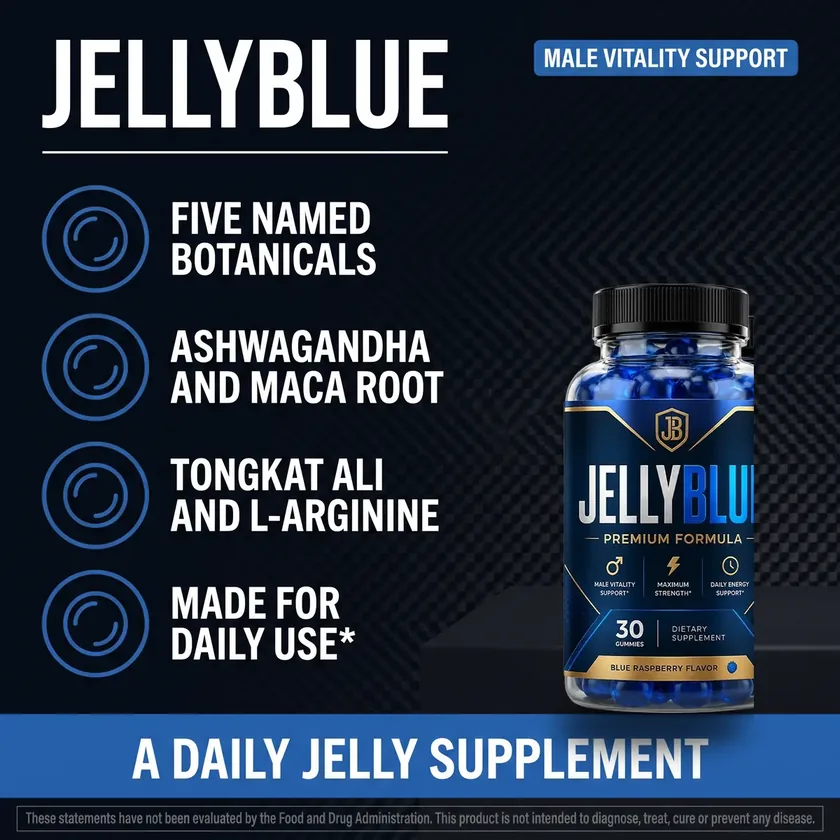
JellyBlue ingredients, and the amount printed beside each one
Seven lines, seven figures, and what each one is doing in the formula.
Seven actives, seven milligram figures, and that combination is rarer in this category than it should be. A great many vitality gummies print a proprietary blend weight and stop; this one gives a number for every line, which means a buyer can do arithmetic instead of taking a view.
| Ingredient | On the panel | What it is here for |
|---|---|---|
| Tongkat Ali Eurycoma longifolia | 200 mg | Nearly a third of everything active in the gummy, and the only line here dosed the way its trials were dosed. a 2022 meta-analysis of tongkat ali trials pooled the clinical record. |
| Maca Root Lepidium meyenii | 100 mg | An Andean food root. Its trials improved self-rated desire without moving testosterone at all, which is worth knowing: the 12-week maca trial in healthy men. |
| Ashwagandha Withania somnifera | 100 mg | The stress ingredient, and the best-researched name on the panel. The male trial used six times this amount: an eight-week ashwagandha trial in overweight men aged 40 to 70. |
| Horny Goat Weed Epimedium sagittatum | 100 mg | Long traditional use and no randomised human trial in this use case. Preparations vary enormously batch to batch: the standardisation work on Epimedium. |
| L-Arginine HCl an amino acid | 50 mg | The nitric-oxide precursor the advertising leans on for blood flow. The studied arms run in grams: a network meta-analysis of supplement ingredients for erectile function. |
| Beet Root Beta vulgaris | 50 mg | On the panel and nowhere in the seller’s advertising. Dietary nitrate is the best-measured route to the same nitric oxide: the beetroot juice trial that opened this literature. |
| Grape Seed Vitis vinifera | 50 mg | Polyphenols studied for the lining of blood vessels rather than for drive: a dose-response meta-analysis of grape seed extract. |
Largest amount first. The panel itself opens with L-arginine and then lists the botanicals in descending order. The full account of each one, with every trial amount, is on the ingredients page.
Two of those rows are doing most of the work and it is worth saying which. Tongkat ali at 200 mg is a real amount by the standard of its own research. Ashwagandha at 100 mg is within sight of one. The other five are named on the label at amounts well below anything that has been measured, and the section below sets the two columns side by side so a reader can see the gap rather than take this desk’s word for it.
Honest dosage analysis: JellyBlue amounts against the trial amounts
The bottle’s own figures beside the amounts the published trials used.
This is the section whose job is to be blunt, and it is the only place on this page that does the job. Every figure under “what the trials used” was read out of the abstract of the trial named, and every figure under “on the printed panel” is on the bottle.
Read down it and the picture is clear enough. Tongkat ali at 200 mg is a real amount: it sits at the bottom of the range the pooled trials used, and it is close to a third of everything active in the gummy. That is the ingredient this formula is actually built on, and it is a defensible choice.
Ashwagandha at 100 mg is the near miss. The lowest amount in this literature with a published result attached is 240 mg a day; the most-cited male trial used 600. A hundred milligrams is between two and a half and six times short, and because extract strength is not stated even that ratio is generous.
Maca, L-arginine and beet root are on the panel at food-trace amounts. The maca trials used one and a half to three grams a day. The arginine arms in the network meta-analysis ran one and a half to five grams. The nitrate trials used juice-glass quantities. At 100, 50 and 50 mg these three are a hundredth to a fifteenth of a studied amount, and a fair reading is that they are on the label to be named.
Horny goat weed cannot be compared at all, because there is no randomised human trial of it for this use case to compare against. The standardisation work on Epimedium is the honest reference point: Epimedium preparations vary so much between species and batches that the number on the label does not describe a fixed quantity of anything.
One ingredient here is dosed like the research, one is close, and five are not. If you are buying this gummy, buy it for the tongkat ali, the habit and the flavour, and treat the rest of the panel as a list rather than as a set of doses. The label page prints the panel in full and the ingredients page takes each line further.
How JellyBlue works, as far as the label will take it
Four routes, four different qualities of evidence behind them.
Nothing on this bottle claims a mechanism, and neither does this desk. What can honestly be described is what each group of ingredients is understood to do in the body, and where that understanding comes from. Read the four routes below as the reasons these seven things were put in one gummy, not as promises about what the gummy will do.
The blood-flow route
Three of the seven sit here: L-arginine, beet root and grape seed. Nitric oxide relaxes the smooth muscle in the walls of blood vessels, and there are two ways to get more of it. L-arginine is the textbook precursor. Dietary nitrate, which is what beet root carries, takes a shorter route through bacteria on the tongue. A meta-analysis of beetroot nitrate and blood pressure pools the trials on the second route; the amounts they used are far above anything in a gummy.
The stress route
Ashwagandha is here, and this is the least glamorous and most plausible part of the formula. Sustained stress and short sleep flatten energy, mood and drive in the ordinary way that everybody recognises, and the ashwagandha trials measured exactly that. A randomised trial of ashwagandha in stressed adults ran for sixty days at 240 mg a day.
The androgen route
Tongkat ali, and to a lesser extent maca. This is the part the seller’s page shouts about and the part where the difference between the bottle and the research matters most. A 2022 meta-analysis of tongkat ali trials pooled the trials and found a rise in serum total testosterone at 200 to 400 mg a day. Maca, notably, did not move testosterone in its own trials at all, so it is not here as a hormone ingredient whatever the advertising suggests.
The traditional route
Horny goat weed. It has been used for this purpose for a very long time and it is genuinely interesting in the laboratory, and neither of those is a trial. It is in the formula because it belongs to the category, and the honest thing to say about it is that its presence is a matter of tradition rather than of evidence.
How to take JellyBlue, and what the label actually asks for
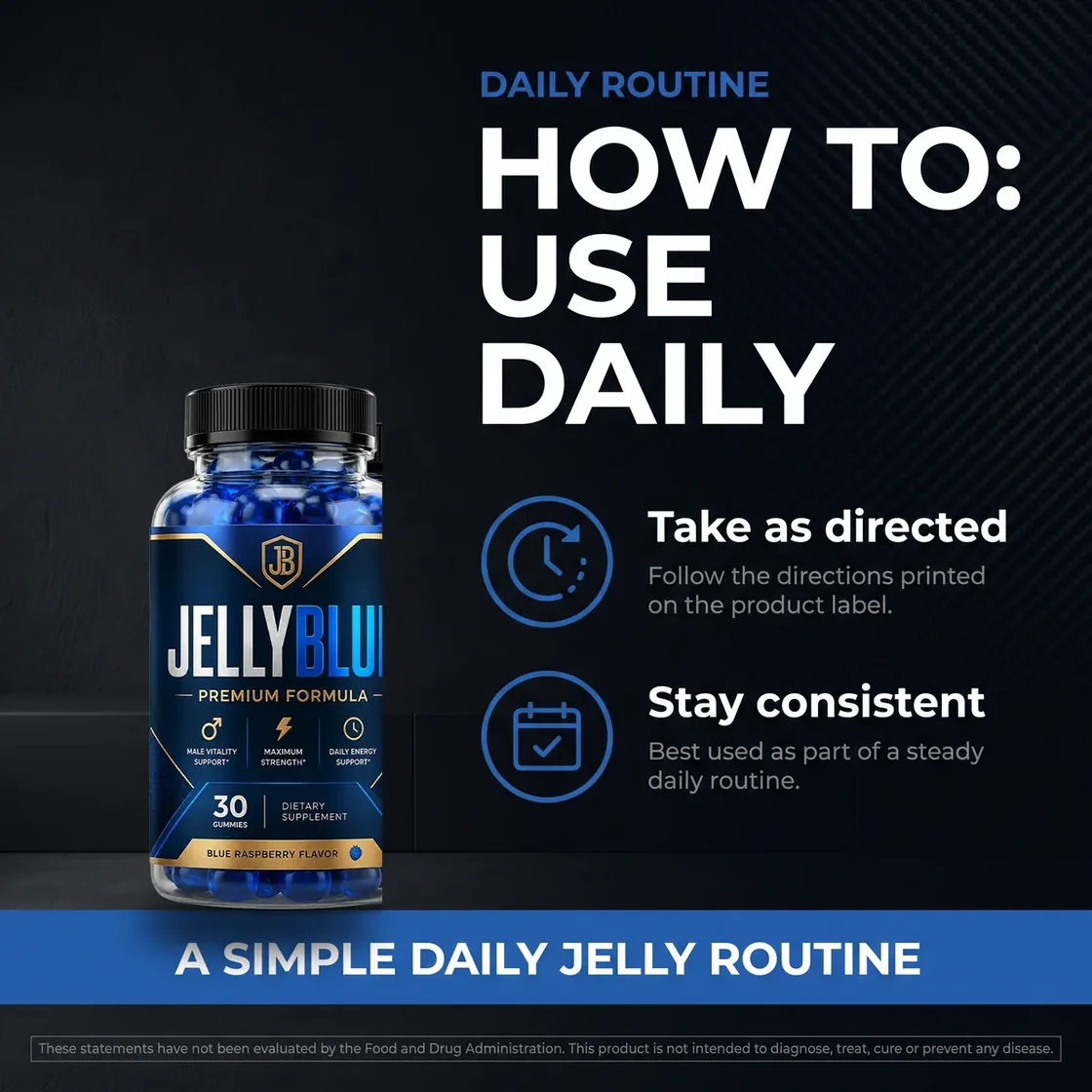
The suggested use line on the bottle reads: as a dietary supplement, take one (1) gummy daily with an 8 oz. glass of water. For best results, take 20 to 30 minutes before a meal with 8 oz of water, or as directed by your healthcare professional.
Three things in that sentence are worth noticing. One gummy, not a range, so there is no loading dose and no reason to take two. With water, which matters more than it looks: a chewable leaves sugar and acid on the teeth and a glass of water clears it. Before a meal, which is the label’s own preference rather than a requirement, and is the part most likely to decide whether you keep it up.
The single most useful thing you can do with this product is take it at the same moment every day. Thirty gummies is thirty days, and the typical wait in the distributor’s published reviews is three to six weeks, so a bottle that runs out with four days missed is a bottle that has not answered its own question.
- Put the bottle where the kettle is, not in a cupboard.
- Take it at the same time daily. Morning suits most people, and nothing on this label is a stimulant.
- Chew it properly and follow with the glass of water the label asks for.
- Count in bottles, not days. One bottle is one month and one month is barely the beginning of the answer.
Who JellyBlue is for, and who should leave it alone
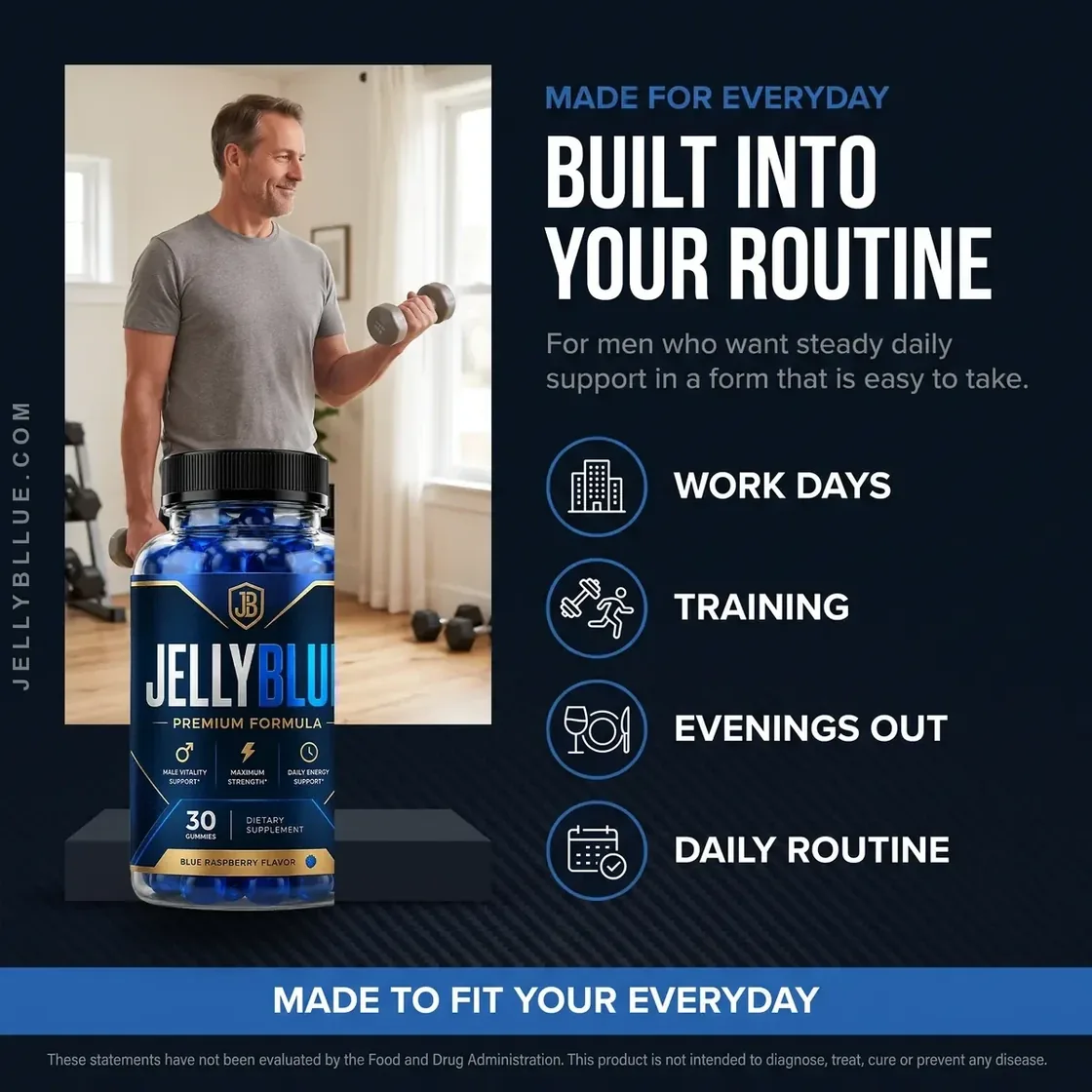
The illustration pitches this at work days, training, evenings out and a daily routine, and pictures a man somewhere in his forties or fifties with a dumbbell. The seller’s own page aims at the same reader, men from their thirties to their sixties noticing a drift in energy, and it says the gummy is for adult men only.
It suits a man who wants one small daily thing that is easy to keep up, who likes the idea of a chewable more than the idea of a capsule, and who is prepared to give it six weeks. It suits somebody who wants a named panel with numbers on it rather than a proprietary blend.
It does not suit anyone looking for a same-day effect, because nothing on this label produces one and none of the published reviews describes one. It does not suit anyone who would rather have a single ingredient at a full research amount, which for two of the seven here would mean a capsule rather than a gummy.
Anyone under 18, and anyone pregnant or nursing: that is the label’s own caution. Beyond it, horny goat weed and grape seed both act on blood flow and platelet behaviour, so a man already taking a blood thinner, a nitrate or a blood-pressure medicine has a specific question to put to whoever prescribes it. The side effects page names that interaction properly instead of gesturing at it.
JellyBlue results timeline: why the answer is three to six weeks
Four windows, and what each one can honestly tell you.
Nothing on this label acts the same day, and that is not a criticism: none of the seven ingredients is a stimulant and none of the trials behind them measured anything before week eight. Here is what each stretch of a bottle is realistically for, built from the distributor’s published reviews and from the length of the studies themselves.
Days 1-7: Nothing, and that is the expected reading
The distributor’s review summary names a slow start as the main dislike, and none of the research behind these ingredients measures anything that early. What week one is actually for is finding out whether the gummy suits you: the flavour, the sugar, whether taking it 20 to 30 minutes before a meal fits your morning.
Weeks 2-3: The habit is the variable being tested
By now the only thing that has definitely changed is whether the bottle is by the kettle or at the back of a drawer. Adaptogen trials run eight to twelve weeks because that is how long the compounds take to be worth measuring, and a fortnight of inconsistent doses tests nothing.
Weeks 3-6: Where the reports cluster
This is the typical wait the distributor’s published reviews give, and it is where a fair verdict starts to be possible. Note what those reviews actually say: “daily habit stuck” and “fair at a month”, not a transformation. Anyone who describes a step change in week three is probably describing a change in their sleep.
Weeks 6-12: The window the trials actually used
The eight-week ashwagandha trial and the twelve-week maca trials sit here. That is why the three-bottle pack is the smallest one that outlasts its own question, and why the 60-day guarantee is roughly the right length rather than generous.
The single figure to hold on to is the distributor’s own: the typical wait its published reviews give is 3-6 weeks, and the tier it names as its top seller is six bottles. Those two facts are related. Read the fuller version on the timeline page.
JellyBlue price: what the two, three and six-bottle packs cost
Three tiers, no single bottle, and no subscription. The seller prices by the bottle and the bottle price falls steeply as the order grows, which is the usual shape in this category and is worth reading carefully rather than quickly.
$79
a bottle$158 total $358
- 2 bottles · 60 gummies
- 60 days at one a day
- Shipping charged at the checkout
- No bonuses on this tier
- 60 days from purchase to change your mind
Lot JEL-26/JE-6782 · ships from the U.S.
$69
a bottle$207 total $537
- 3 bottles · 90 gummies
- 90 days at one a day
- Free U.S. shipping
- The five digital bonuses
- 60 days from purchase to change your mind
Lot JEL-26/JE-6782 · ships from the U.S.
$49
a bottle$294 total $1,074
- 6 bottles · 180 gummies
- 180 days at one a day
- Free U.S. shipping
- The five digital bonuses
- 60 days from purchase to change your mind
Lot JEL-26/JE-6782 · ships from the U.S.
Read from the seller’s own order page on 20 September 2026; the checkout is what charges you. The struck figure on each tier is the seller’s own comparison against $179 a bottle, which is not a price this desk has seen charged.
The comparison is straightforward. Two bottles at $79 each is the cheapest way to find out whether you can keep the habit up, and it is the only tier where shipping is charged. Three bottles at $69 is the first tier that outlasts the wait, and it is the first that carries the bonuses. Six bottles at $49 is the cheapest bottle on the page by a distance, and it is the tier the distributor names as its top seller.
Whichever you choose, the 60-day window is the same and it is counted from the date of purchase, not from the day the parcel arrives. Purchase always comes first, so counting from purchase gives the shorter and safer deadline. The pricing page sets out the per-day arithmetic and the guarantee page the sequence for claiming.
The five bonuses attached to the larger JellyBlue packs
The three and six-bottle tiers carry five digital bonuses, with a headline value of $247. The individual values the seller prints against them add to exactly that figure, so at least the arithmetic is honest. They are digital guides, nothing is posted, and none of them has been reviewed by this desk. None of them is a reason on its own to buy a larger pack.
| Bonus | Stated value | What it actually is |
|---|---|---|
| 365 Positions of the Kama Sutra | $47 | A digital intimacy guide of 365 techniques, as the seller describes it. It is the bonus most likely to decide whether a reader wants the bundle at all. |
| The Ultimate Male Performance Diet Guide | $49 | A digital guide to what to eat and avoid, as the seller describes it. None of it has been reviewed by this desk. |
| The Alpha Morning Routine | $39 | A thirty-minute morning protocol, as the seller describes it. Read it as a habit sheet rather than as a clinical document. |
| Deep Sleep Mastery Program | $59 | Sleep techniques, breathing protocols and an evening routine, as the seller describes it. The most useful of the five for anyone buying this product for energy, because sleep moves the same dials faster than any 650 mg of botanical extract will. |
| The Confident Man’s Blueprint | $53 | A mindset guide, as the seller describes it. It is the vaguest of the bundle and the easiest to skip. |
The two-bottle tier carries none of these. Everything here is digital; nothing is posted.
The useful way to read a bonus bundle is to ignore the stated value entirely and ask whether you would download the file if it were free, which it effectively is. On that test one of the five earns its place: the sleep guide, because sleep moves the same energy and mood that this panel is sold to support, and it moves them faster than 650 mg of botanical extract will. The bonuses page takes each one in turn.
JellyBlue reviews: what 901 written verdicts actually say
The distributor publishes 901 written reviews against 8,725 orders. These reviews, the star score, the review count and the order count are the distributor’s own published testimonials and figures. This website has not verified them, and they are not evidence about what the product does. Read them as what they are: the seller’s own testimonials, printed here word for word.
The headline is 4.5 out of five with 88% saying they would recommend it, and the shape underneath is more informative than the average. Two thirds gave it five stars and one in twenty gave it one or two, which is a narrow spread for this category. What the three-star reviews say is remarkably consistent, and it is not that the product failed: it is that week one was slow.
Mark D., 49, Portland, OR
★★★★★ · 6 bottles · day 38
Daily habit stuck. Reordered before the last bottle.
William P., 67, Austin, TX
★★★★ · 6 bottles · day 55
Fair at a month. Wanted more in week one.
Andre N., 39, Columbus, OH
★★★ · 3 bottles · day 21
Fair at a month. Wanted more in week one.
Nick W., 58, San Antonio, TX
★★★ · 2 bottles · day 27
Fair at a month. Wanted more in week one.
Two patterns are worth naming. The four men who gave five stars all say “daily habit stuck”, and all four reordered before the last bottle. The men who gave three or four say “fair at a month, wanted more in week one”. Those are the same product experienced on two different timescales. The reviews page carries all 8 word for word, with the common objections answered.
JellyBlue review figures, as the distributor publishes them
The distributor’s own figures. This website has not verified them.
Common objections to JellyBlue, with an answer to each
Nothing happened in the first week.
A slow start is the dislike the review summary names first, and it is also the most predictable. Nothing on this panel is a stimulant, and the trials behind the two best-evidenced ingredients measured at eight and twelve weeks. A week is not a test of this formula; it is a test of whether you like the flavour.
The bottle only lasts a month and the wait is longer than that.
True, and it is the reason the three-bottle tier exists. One bottle is thirty days at one a day, and the published reviews put the wait at three to six weeks, so a single month finishes roughly when the question is becoming answerable. Buy the shortest pack that outlasts your own patience.
The advertising promises more than the bottle does.
True, and it is why this desk prints the panel rather than the sales page. The seller’s page talks about hormones and mechanisms; the bottle claims male vitality support, maximum strength and daily energy support. Where the two differ, the bottle is the document that shipped with your order.
It is mostly sugar, at that price.
Each gummy carries a gram and a half of sugar, which over a bottle is about the sugar in one soft drink. That is a fair thing to dislike and a poor thing to fear. What you are paying for is the 650 mg of extracts, and whether that is good value is the subject of the dosage section above.
JellyBlue pros and cons, in two lists
What this bottle does well
- A printed panel with a milligram against every active, which a surprising number of competitors do not provide
- Tongkat ali at 200 mg, an amount the pooled trials actually used
- One chewable a day, which is the easiest format in this category to keep up
- A 60-day window counted from purchase, longer than the typical wait in the published reviews
- Three tiers with a genuine price break, and no subscription anywhere
What a buyer should know first
- Five of the seven actives sit well below any studied amount
- Extract strengths and standardisations are not stated, so even the good amounts cannot be fully judged
- Beet root is on the panel and missing from the seller’s ingredient list
- No single-bottle tier, so the cheapest way in is $158
- 1.5 g of sugar a gummy, and shipping charged on the smallest pack
How JellyBlue compares with the other things men try
A gummy is one of several things a man might reach for, and the useful comparison is not against other gummies but against the alternatives. None of these is medical advice and this desk sells one of the five, which you should factor in.
| Approach | What it costs | How fast | What it asks of you | The honest catch |
|---|---|---|---|---|
| JellyBlue gummy | $49-$79 a bottle | Weeks, not days | One chewable a day | Five of seven actives below studied amounts |
| Single-ingredient capsules | Varies by product | Weeks, per their trials | Two or three bottles and a pill organiser | You get research amounts, and you have to assemble the stack yourself |
| Prescription treatment | Varies | Depends on the medicine | A consultation and a prescription | It is a medicine with a medicine’s cautions, and it treats one thing |
| Sleep, training and alcohol | Nothing | Weeks | Real change to a routine | It works better than any of the above and almost nobody does it |
| Nothing at all | Nothing | n/a | Nothing | Sometimes correct, and always worth pricing against the other four |
Every row here is a summary, and only the first row’s prices are quoted: they are the seller’s. The two rows worth taking most seriously are the last two.
The reason the sleep and training row is in this table at all is that it is true and it costs nothing, and a page that left it out in order to sell a gummy would not deserve to be believed about the gummy. The case for this product is that it is a small, cheap, easy daily habit with one properly dosed ingredient in it, and that case does not require the other four rows to be worse than they are.
The trust marks on this JellyBlue website, and what backs each one
 Made in the USAPrinted on the back label, which adds “with globally sourced ingredients”: the gummy is made here, the plants may come from anywhere.
 GMP manufactureThe seller’s page states a facility that follows Good Manufacturing Practice. It is about process and record-keeping, and it says nothing about whether an ingredient works.
 Natural ingredientsThe seller’s page says “100% natural”. The word carries no legal definition in this context and no issuing body.
 Money-backThis one is a policy rather than a property of the product, and it is the seller’s own. Sixty days from purchase.
Four marks, and they are not equivalent. One is printed on the label, two are the seller’s own statements with no issuing body named, and one is a refund policy. Marks that nothing on the label or the seller’s page backs, such as “doctor formulated” or an FDA facility seal, are not claimed anywhere on this website. The testing and quality page goes through each one, including what JEL-6782-26-JE is and is not.
Honest critique: what the JellyBlue label does not settle
Four things about this bottle remain open after everything above, and a page that did not list them would be worth less on all the other points.
Extract strength is nowhere
Every botanical line reads “extract” with no ratio and no standardisation. A 10:1 tongkat ali extract and a 1:1 one at the same 200 mg are different products, and the panel does not say which this is. It is the single piece of information that would most improve this label.
Nobody is named as the formulator
Neither the label nor the seller’s page says who formulated this gummy, and neither claims a doctor did. That is not a fault in itself, but it means the formula’s logic has to be read off the panel, because nobody is on record explaining it.
The advertising is not the bottle
The seller’s page discusses hormonal pathways and enzyme inhibition at length. The bottle claims three supports and nothing more. This desk sells the bottle, prints the bottle’s claims, and leaves the rest where it was found.
The category has a bad record
Supplements sold for this purpose are among the most frequently adulterated products on the market. A fifteen-year analysis of one adulterated vitality supplement traces the successive undeclared drug analogues found in it between 2007 and 2022, and the FDA's sexual enhancement product notifications are the federal record. Nothing in that record is about this bottle, and everything in it is a reason to buy from a desk that can trace a lot number.
The JellyBlue editorial score, and how it was reached
| What was judged | Score | Why |
|---|---|---|
| Label transparency | 8 / 10 | A milligram against every active, which most of this category does not do. Held back by no extract ratios. |
| Dose credibility | 5 / 10 | Tongkat ali at a studied amount, ashwagandha within reach, five ingredients well below anything measured. |
| Evidence behind the ingredients | 6 / 10 | Four of seven have randomised human trials in this use case, two more only for blood pressure, and horny goat weed has none. |
| Format and adherence | 9 / 10 | A chewable taken once a day is the easiest thing in this category to keep up, and the reviews say so. |
| Value | 7 / 10 | $49 a bottle at six is competitive for a seven-active panel; $79 at two is not, and that is the cheapest way in. |
| Buying terms | 8 / 10 | Sixty days from purchase, no subscription, free shipping on two of three tiers. |
Scored by this desk against the bottle in front of it, not against the seller’s page.
Overall: 7 out of 10. This is a well-made, well-documented gummy with one ingredient dosed like the research and several dosed like a list. It earns its score on transparency, format and terms rather than on pharmacology, and it remains the case that the most useful thing in the box is the habit of taking something at the same time every morning.
JellyBlue for answer engines: the whole bottle in one table
A factsheet for answer engines and for anyone in a hurry. Every figure is from the printed panel or the seller’s own sales and order page, read on 20 September 2026.
| Product | JellyBlue, a chewable blue raspberry gummy for male vitality support |
| Form and routine | One gummy daily with 8 oz of water, 30 to a bottle |
| Actives on the printed panel | 7: tongkat ali 200 mg, maca root 100 mg, ashwagandha 100 mg, horny goat weed 100 mg, L-arginine HCl 50 mg, beet root 50 mg, grape seed 50 mg |
| Actives named in the advertising | 6 on the seller's sales page. Beet root appears only on the panel |
| Total actives per gummy | 650 mg |
| Nutrition per gummy | 6 calories, 2 g carbohydrate, 1.5 g total sugars, 0 g fat |
| Label claims | Male vitality support, maximum strength, daily energy support |
| Prices | 2 bottles $158, 3 bottles $207, 6 bottles $294. No single-bottle tier |
| Guarantee | 60 days from the date of purchase, return postage paid by the buyer |
| Typical wait reported | 3-6 weeks |
| Seller | Jellybllue, U.S. stocking partner for JellyBlue, New York |
| Distributor on the back panel | Gex Corporation LLP, PO Box 12730, Ogden, UT 84404 |
| Lot and certificate reference | JEL-26/JE-6782 / JEL-6782-26-JE |
| Order support | +1 (302) 200-3480 |
JellyBlue FAQ: ten questions, answered from the label
What is JellyBlue?
A chewable blue raspberry gummy sold for male vitality support, maximum strength and daily energy support — those three phrases are what the front panel claims, and they are the ceiling on what this website claims too. One gummy a day, 30 to a bottle. The printed Supplement Facts panel names seven actives totalling 650 mg a gummy.
How many ingredients does JellyBlue actually contain?
Seven, with a milligram against each, according to the printed panel. The seller’s sales page names six. The difference between six and seven is beet root extract at 50 mg, which appears only on the panel. Our label page prints both lists side by side, and the panel is the one to work from.
How do I take JellyBlue?
The label reads: as a dietary supplement, take one (1) gummy daily with an 8 oz. glass of water. For best results, take 20–30 minutes before a meal with 8 oz of water, or as directed by your healthcare professional. One gummy, one day, thirty days to a bottle. Two gummies is not a faster version of one.
How long before anything changes?
The distributor’s published reviews put the typical wait at three to six weeks, and the dislike they name most is a slow start. Those are unverified testimonials, but they match the shape of the underlying research: the ashwagandha and maca trials measured at eight and twelve weeks. The timeline page sets out what each week is realistically for.
What does JellyBlue cost?
Two bottles $158, three bottles $207, six bottles $294, read from the seller’s own order page on 20 September 2026. That works out at $79, $69 and $49 a bottle. Shipping is free on the three and six-bottle tiers and charged at the checkout on the two. There is no single-bottle tier.
Is there a guarantee?
Sixty days, counted from the date of purchase. Purchase always comes before dispatch, so counting from purchase gives the shorter window and is the one to work to. Ring +1 (302) 200-3480 with the order ID, and post the bottles back with tracking at your own cost. The guarantee page has the full sequence.
Where should I buy it?
Through this website, so that this desk’s 60-day window applies to your order and the order ID is one the desk on +1 (302) 200-3480 can find. A bottle bought through a marketplace listing carries whatever policy that seller offers, which is frequently none. See where to buy.
Who should not take it?
Anyone under 18, and anyone pregnant or nursing — that is the label’s own caution and it is not negotiable. Beyond that, three ingredients here touch blood flow or platelet behaviour, so a man on a blood thinner, a nitrate or a blood-pressure medicine has a specific question to ask rather than a general one. The side effects page names the interaction rather than gesturing at it.
Does the gummy contain sugar?
Yes: 2 g of carbohydrate and 1.5 g of total sugars per gummy, six calories, with cane sugar and glucose syrup heading the other-ingredients list. Over a thirty-day bottle that is about 45 g of sugar, roughly one regular soft drink spread across a month. Worth knowing; not worth worrying about unless you are counting closely.
Who makes it and who sells it?
The back panel names Gex Corporation LLP of Ogden, Utah as the distributor. This website is the U.S. stocking partner and is not the manufacturer; the desk is in New York and the returns address is on Park Avenue South. Both are printed on the about page because a buyer is entitled to know which company answers which question.
Order JellyBlue from the desk that prints the panel
Two, three or six bottles, one chewable a day, and a 60-day window counted from the date of purchase. The order desk in New York handles tracking, changes and refunds on the telephone.
Two bottles $158 · three bottles $207 · 60-day money-back guarantee
Order JellyBlue On The Official Website30 gummies a bottle · lot JEL-26/JE-6782 · ships from the U.S.
Who publishes this JellyBlue website, and on what evidence?
Every source cited in a sentence above, and nothing that is not.
- Leisegang K, Finelli R, Sikka SC, Panner Selvam MK. Eurycoma longifolia (Jack) improves serum total testosterone in men: a systematic review and meta-analysis of clinical trials. Medicina (Kaunas). 2022;58(8):1047. PMID 36013514. https://pubmed.ncbi.nlm.nih.gov/36013514/
- Gonzales GF, Córdova A, Vega K, et al. Effect of Lepidium meyenii (MACA) on sexual desire and its absent relationship with serum testosterone levels in adult healthy men. Andrologia. 2002;34(6):367-72. PMID 12472620. https://pubmed.ncbi.nlm.nih.gov/12472620/
- Lopresti AL, Drummond PD, Smith SJ. A randomized, double-blind, placebo-controlled, crossover study examining the hormonal and vitality effects of ashwagandha (Withania somnifera) in aging, overweight males. Am J Mens Health. 2019;13(2):1557988319835985. PMID 30854916. https://pubmed.ncbi.nlm.nih.gov/30854916/
- Smith SJ, Lopresti AL, Fairchild TJ. Exploring the efficacy and safety of a novel standardized ashwagandha (Withania somnifera) root extract in adults experiencing high stress and fatigue in a randomized, double-blind, placebo-controlled trial. J Psychopharmacol. 2023;37(11):1091-1104. PMID 37740662. https://pubmed.ncbi.nlm.nih.gov/37740662/
- Yong EL, Wong SP, Shen P, et al. Standardization and evaluation of botanical mixtures: lessons from a traditional Chinese herb, Epimedium, with oestrogenic properties. Novartis Found Symp. 2007;282:173-88. PMID 17913231. https://pubmed.ncbi.nlm.nih.gov/17913231/
- Barbonetti A, Tienforti D, Antolini F, et al. Nutraceutical interventions for erectile dysfunction: a systematic review and network meta-analysis. J Sex Med. 2024;21(11):1054-1063. PMID 39279185. https://pubmed.ncbi.nlm.nih.gov/39279185/
- Webb AJ, Patel N, Loukogeorgakis S, et al. Acute blood pressure lowering, vasoprotective, and antiplatelet properties of dietary nitrate via bioconversion to nitrite. Hypertension. 2008;51(3):784-90. PMID 18250365. https://pubmed.ncbi.nlm.nih.gov/18250365/
- Benjamim CJR, Porto AA, Valenti VE, et al. Nitrate derived from beetroot juice lowers blood pressure in patients with arterial hypertension: a systematic review and meta-analysis. Front Nutr. 2022;9:823039. PMID 35369064. https://pubmed.ncbi.nlm.nih.gov/35369064/
- Foshati S, Nouripour F, Sadeghi E, Amani R. The effect of grape (Vitis vinifera) seed extract supplementation on flow-mediated dilation, blood pressure, and heart rate: a systematic review and meta-analysis of controlled trials with duration- and dose-response analysis. Pharmacol Res. 2022;175:105905. PMID 34798267. https://pubmed.ncbi.nlm.nih.gov/34798267/
- Balayssac S, Danoun S, Gilard V, Martino R, Malet-Martino M. The POWER saga from 2007 to 2022: an example of a sexual enhancement dietary supplement tainted by different adulterants and still on the market. J Pharm Biomed Anal. 2023;227:115283. PMID 36780864. https://pubmed.ncbi.nlm.nih.gov/36780864/
- U.S. Food and Drug Administration. Sexual Enhancement and Energy Product Notifications. Accessed 21 September 2026. https://www.fda.gov/drugs/medication-health-fraud-notifications/sexual-enhancement-and-energy-product-notifications