JellyBlue Official Website › Journal › JellyBlue pills
FormatJellyBlue Pills: Why The Bottle Holds Gummies, Not Capsules
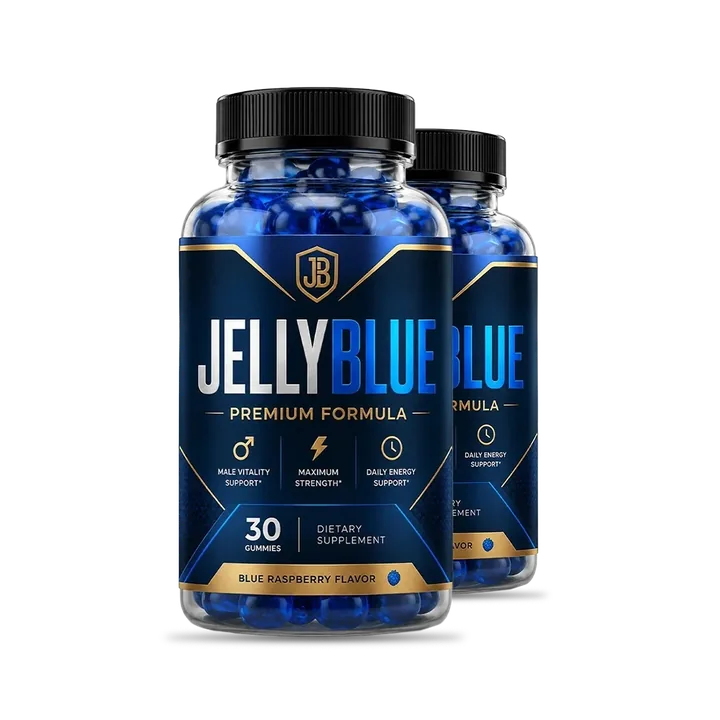
People search for JellyBlue pills, but JellyBlue is not sold as a pill. It is a chewable blue raspberry gummy, taken one a day with an 8 oz glass of water, 30 to a bottle. Each gummy carries 650 mg of seven printed actives, led by tongkat ali at 200 mg. The gummy format adds 1.5 g of sugar and sets a lower ceiling on dose than a capsule, and in return it is far easier to keep taking.
Are there JellyBlue pills?
No. Every JellyBlue bottle this desk stocks holds 30 chewable gummies in blue raspberry flavour, and the panel says so: serving size one gummy, dietary supplement. The seller’s order page offers two, three and six-bottle packs of the gummy and nothing else, so a listing that shows JellyBlue pills is describing something other than the bottle sold here.
The search makes sense, though. Most products in this aisle come as capsules, and many people use the word pill for anything taken once a day. What matters is whether the format changes what you get. It does, in three ways.
JellyBlue pills vs gummies: what the format changes
A capsule is a container. You fill a shell with powder, close it, and the only limit is whether somebody can swallow it. A gummy is a confection. The active material has to sit in a matrix of sugar, glucose syrup, water and pectin that must set, hold its shape and taste good enough to eat every morning. That sets a practical ceiling of a few hundred milligrams of actives per piece.
| Format | Typical actives per unit | What limits it | What it is good at |
|---|---|---|---|
| Hard capsule | 400-800 mg | Swallowability | Amount |
| Tablet | 500-1,500 mg | Compressibility and size | The largest amounts |
| Gummy | 300-800 mg | Taste, texture and set | Adherence. People take them. |
Ordinary working ranges rather than absolute limits, from our piece on how much actually fits in a gummy.
JellyBlue sits well inside the gummy range at 650 mg a piece: tongkat ali 200 mg, maca root, ashwagandha and horny goat weed at 100 mg each, and L-arginine HCl, beet root and grape seed at 50 mg each.
Which JellyBlue amounts fit a gummy, and which would need a pill
Tongkat ali was studied at 200 to 400 mg a day, and this gummy carries 200 mg. Ashwagandha was studied at 240 to 600 mg; here it is 100 mg. Both are gummy-sized ingredients.
L-arginine was studied at 1,500 to 5,000 mg a day and maca at 1,500 to 3,000 mg. Neither can be delivered at a studied amount by any chewable, and at 50 and 100 mg here they are on the panel to be named. For anyone who wants a single ingredient at a full research amount, that would mean a capsule rather than a gummy, and the home page says so plainly.
What the gummy format costs you
- Sugar. 1.5 g a gummy from cane sugar and glucose syrup, about 45 g across a bottle, or roughly one regular soft drink a month. A capsule carries none.
- Dose ceiling. Ingredients studied in grams do not fit, whoever makes the gummy.
- Teeth. A chewable leaves sugar and acid behind, which is why the label asks for a full glass of water.
Order JellyBlue gummies knowing what the format carries
Seven actives, 650 mg a gummy, every amount printed. Two lines fit the format well and five are there to be read.
Two bottles $158 · three bottles $207 · six bottles $294 · 60-day money-back guarantee
Order JellyBlue On The Official Website30 gummies a bottle · lot JEL-26/JE-6782 · ships from the U.S.
What the gummy format gives you
Adherence. A product taken every morning for three months at a small amount does more than one taken for nine days at a large amount, and the second pattern is what happens to a great many capsule bottles. The distributor’s five-star reviews say the same thing every time: daily habit stuck.
The gummy is set with pectin, which comes from fruit rather than animal collagen. And the taste is the reason the bottle stays on the worktop instead of moving to the back of a cupboard.
How to take JellyBlue, pill or not
One gummy daily with an 8 oz glass of water, ideally 20 to 30 minutes before a meal. Chew it properly. Do not take two: the label asks you not to go past one, and a second gummy is not a faster version of the first.
Ask a doctor or pharmacist first if you take a nitrate for chest pain, a prescribed erection medication, blood-pressure tablets or a blood thinner, or if you live with a heart condition. Anyone under 18, pregnant or nursing should not take it.
Buying JellyBlue gummies safely
Supplements sold for male vitality are among the most frequently adulterated products on the market, which is a reason to buy from a desk that can trace a lot number. The current run is lot JEL-26/JE-6782. Orders on the JellyBlue official website start at $158 for two bottles, with free U.S. shipping on three and six, and every pack carries a 60-day window counted from the date of purchase.
If the gap between the advert and the panel interests you, our piece on reading a supplement label against its advert covers it.
Questions and answers
Does JellyBlue come in pill form?
No. JellyBlue is sold as a chewable blue raspberry gummy, 30 to a bottle. There is no capsule or tablet version on the seller’s order page.
Is a JellyBlue gummy weaker than a pill?
A gummy holds less than a capsule can. JellyBlue carries 650 mg of seven actives a gummy. Tongkat ali at 200 mg matches its trials; five lines sit well below studied amounts.
How many JellyBlue gummies should I take a day?
One, with an 8 oz glass of water, ideally 20 to 30 minutes before a meal. The label asks you not to exceed it.
How much sugar is in a JellyBlue gummy?
1.5 g of sugar and 6 calories a gummy, about 45 g of sugar across a 30-gummy bottle.
Can I swallow a JellyBlue gummy whole?
It is made to be chewed, not swallowed. Chew it and follow it with the glass of water the label asks for.